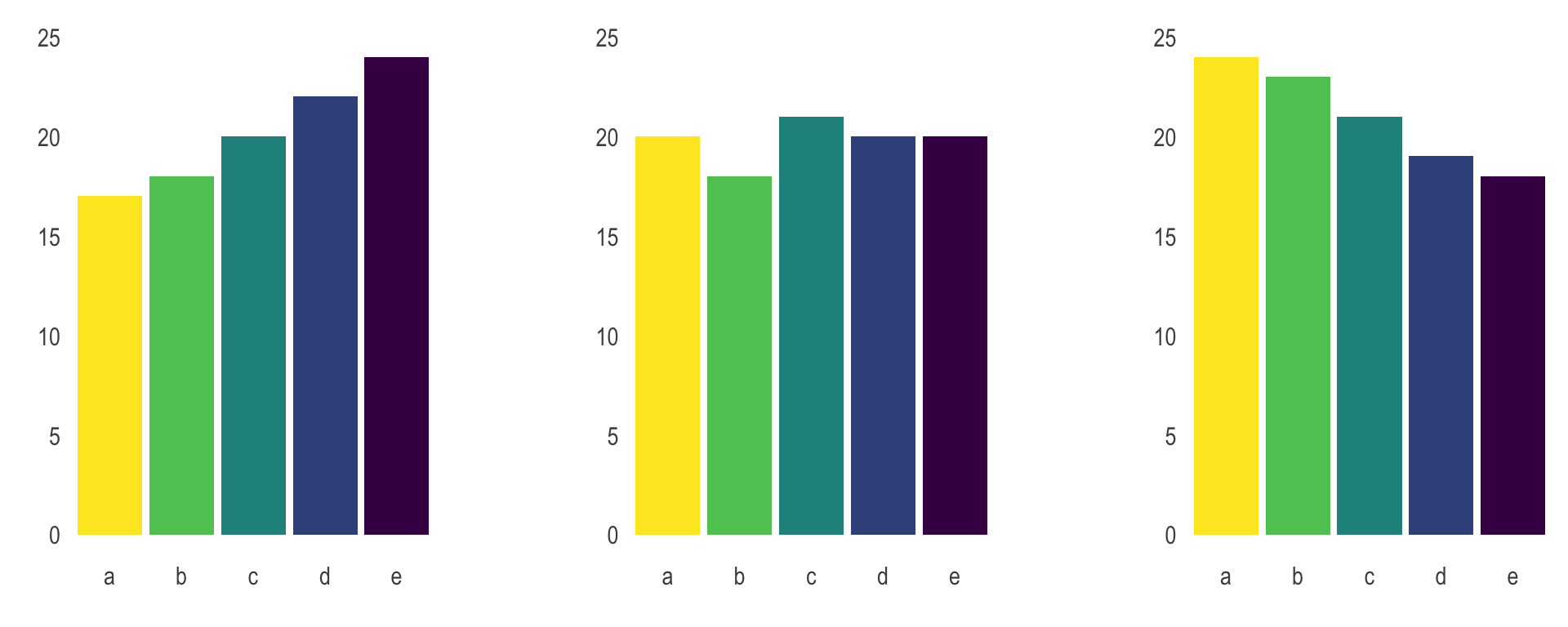
Data science communication

Lecture 13

John Zito

Duke University
STA 199 Spring 2026

2026-03-02

While you wait: Participate 📱💻

Your first peer evaluation for your project is due at midnight tonight. You should have received an e-mail from TEAMMATES about it (check your junk folder!). Did you complete it yet?

  • Yes
  • No

Scan the QR code or go HERE. Log in with your Duke NetID.

Reminder

  • Project feedback returned today;
  • Make progress (clean, plot, summarize) by Wednesday night;
  • Thursday lab: continue to work and give another team feedback;
  • Friday: complete midsemester check-in;
  • Friday: Midterm 1 grades returned.

Forget this class exists during spring break. After we return, our last six weeks are about statistical modeling and inference.

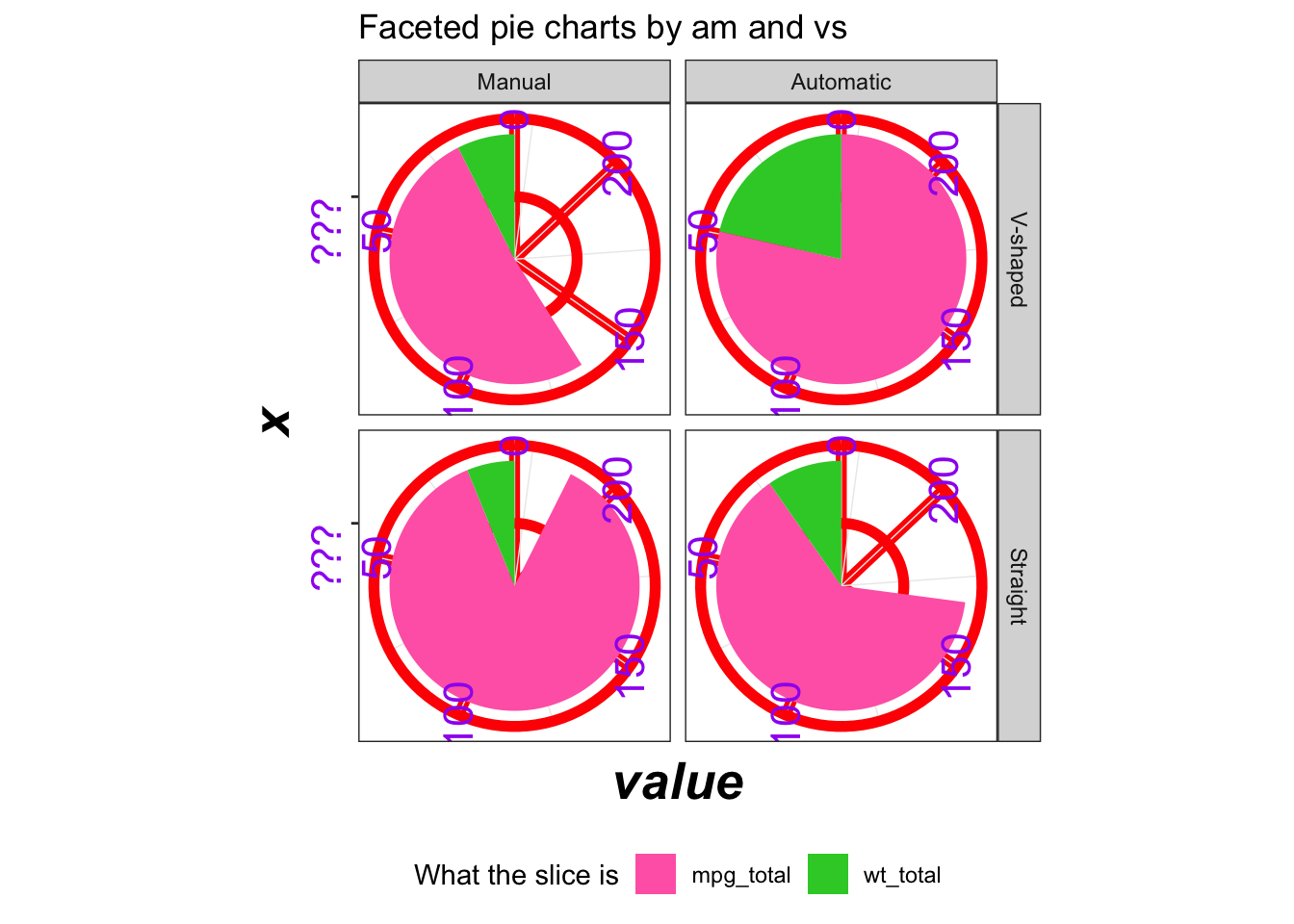
Ugly plot

Honorable mention: Ben Mei-Dan

Code
mtcars |> 
  mutate(am = factor(am,
                       levels = c(1, 0),
                       labels = c("Manual", "Automatic"))) |> 
  mutate(vs = factor(vs, 
                     levels = c(0,1),
                     labels = c("V-shaped", "Straight"))) |> 
  group_by(am, vs) |> 
  summarize(mpg_total = sum(mpg), wt_total = sum(wt), .groups = "drop") |>
  pivot_longer(
    cols = c(mpg_total, wt_total),
    names_to = "metric",
    values_to = "value") |> 
  ggplot(aes(x = "", y = value, fill = metric)) + 
  geom_col(show.legend = TRUE) +
  coord_polar(theta = "y") +
  facet_grid(vs ~ am) +
  labs(
    title = "Faceted pie charts by am and vs",
    fill = "What the slice is"
  ) + 
  scale_fill_manual(values = c("hotpink", "limegreen")) +
  scale_y_reverse() +
  scale_x_discrete(labels = c("???")) + 
  theme_bw() +
  theme(
    legend.position = "bottom",
    axis.text = element_text(angle = 90, size = 16, color = "purple"),
    axis.title = element_text(size = 20, face = "bold.italic"),
    panel.grid.major = element_line(color = "red", size = 2)
  )

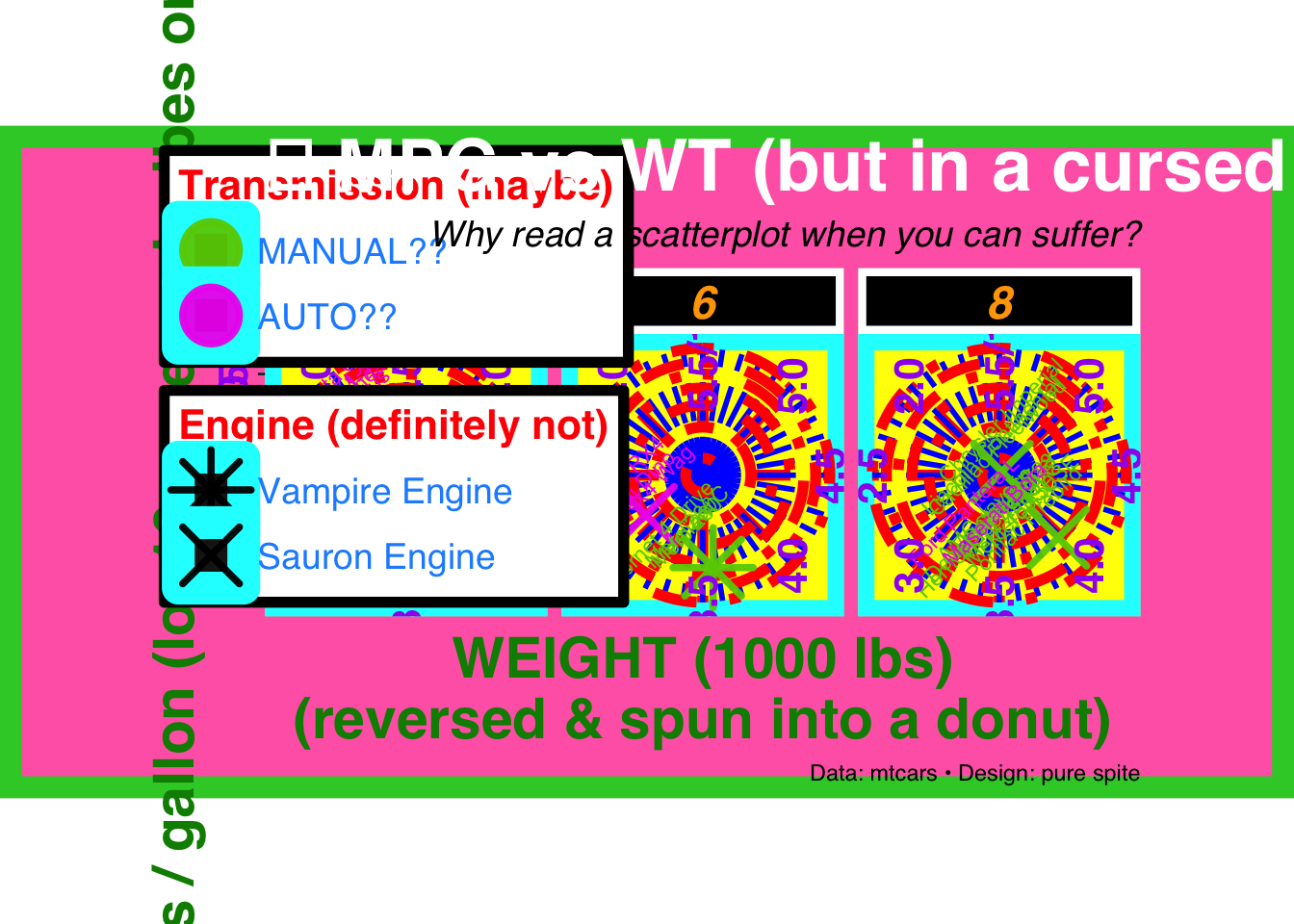
Honorable mention: Celina Chen

Code
ggplot(
  mtcars,
  aes(
    x = wt,
    y = mpg,
    color = factor(am, levels = c(1, 0)),
    shape = factor(vs, levels = c(1, 0))
  )
) +
  # Giant points + jitter = chaos
  geom_point(
    size = 9,
    alpha = 0.95,
    stroke = 2,
    position = position_jitter(width = 0.25, height = 1.5)
  ) +
  # Overlapping labels for maximum visual pain
  geom_text(
    aes(label = row.names(mtcars)),
    size = 3,
    angle = 45,
    vjust = -0.4,
    show.legend = FALSE
  ) +
  # Fragment into panels
  facet_wrap(~cyl, nrow = 1) +
  # Reverse + weird limits + tons of minor breaks
  scale_x_reverse(
    limits = c(5.5, 1.5),
    breaks = seq(5.5, 1.5, -0.5),
    minor_breaks = seq(5.5, 1.5, -0.1)
  ) +
  # Reverse + log transform = extra confusing
  scale_y_reverse(
    trans = "log10",
    limits = c(35, 8),
    breaks = c(35, 30, 25, 20, 15, 10, 8)
  ) +
  # Weaponized color choices + misleading labels
  scale_color_manual(
    values = c("magenta2", "chartreuse3"),
    labels = c("AUTO??", "MANUAL??"),
    guide = guide_legend(reverse = TRUE, title.position = "top")
  ) +
  # Aggressive shapes that don’t help interpretation
  scale_shape_manual(
    values = c(8, 4),
    labels = c("Vampire Engine", "Sauron Engine")
  ) +
  # Turn a scatterplot into a donut of confusion
  coord_polar(theta = "x") +
  labs(
    title = "💀 MPG vs WT (but in a cursed universe) 💀",
    subtitle = "Why read a scatterplot when you can suffer?",
    x = "WEIGHT (1000 lbs)\n(reversed & spun into a donut)",
    y = "Miles / gallon (log10, reversed, vibes only)",
    color = "Transmission (maybe)",
    shape = "Engine (definitely not)",
    caption = "Data: mtcars • Design: pure spite"
  ) +
  theme(
    # Use safe fonts so Quarto can render (no Comic Sans errors)
    text = element_text(family = "sans"),

    plot.background  = element_rect(fill = "hotpink", color = "limegreen", linewidth = 8),
    panel.background = element_rect(fill = "yellow",  color = "cyan", linewidth = 6),
    panel.grid.major = element_line(color = "red",  linewidth = 2, linetype = "dotdash"),
    panel.grid.minor = element_line(color = "blue", linewidth = 1, linetype = "longdash"),
    strip.background = element_rect(fill = "black", color = "white", linewidth = 3),

    strip.text = element_text(color = "orange", size = 18, face = "bold.italic"),
    axis.text  = element_text(color = "purple", size = 16, face = "bold", angle = 90, vjust = 0.5),
    axis.title = element_text(color = "green4", size = 22, face = "bold"),
    plot.title = element_text(color = "white", size = 28, face = "bold", hjust = 0),
    plot.subtitle = element_text(color = "black", size = 14, face = "italic", hjust = 1),

    legend.position = c(0.15, 0.85),
    legend.background = element_rect(fill = "white", color = "black", linewidth = 2),
    legend.key = element_rect(fill = "grey10"),
    legend.text  = element_text(color = "dodgerblue", size = 14),
    legend.title = element_text(color = "red", size = 16, face = "bold"),

    plot.margin = margin(5, 60, 5, 60)
  )

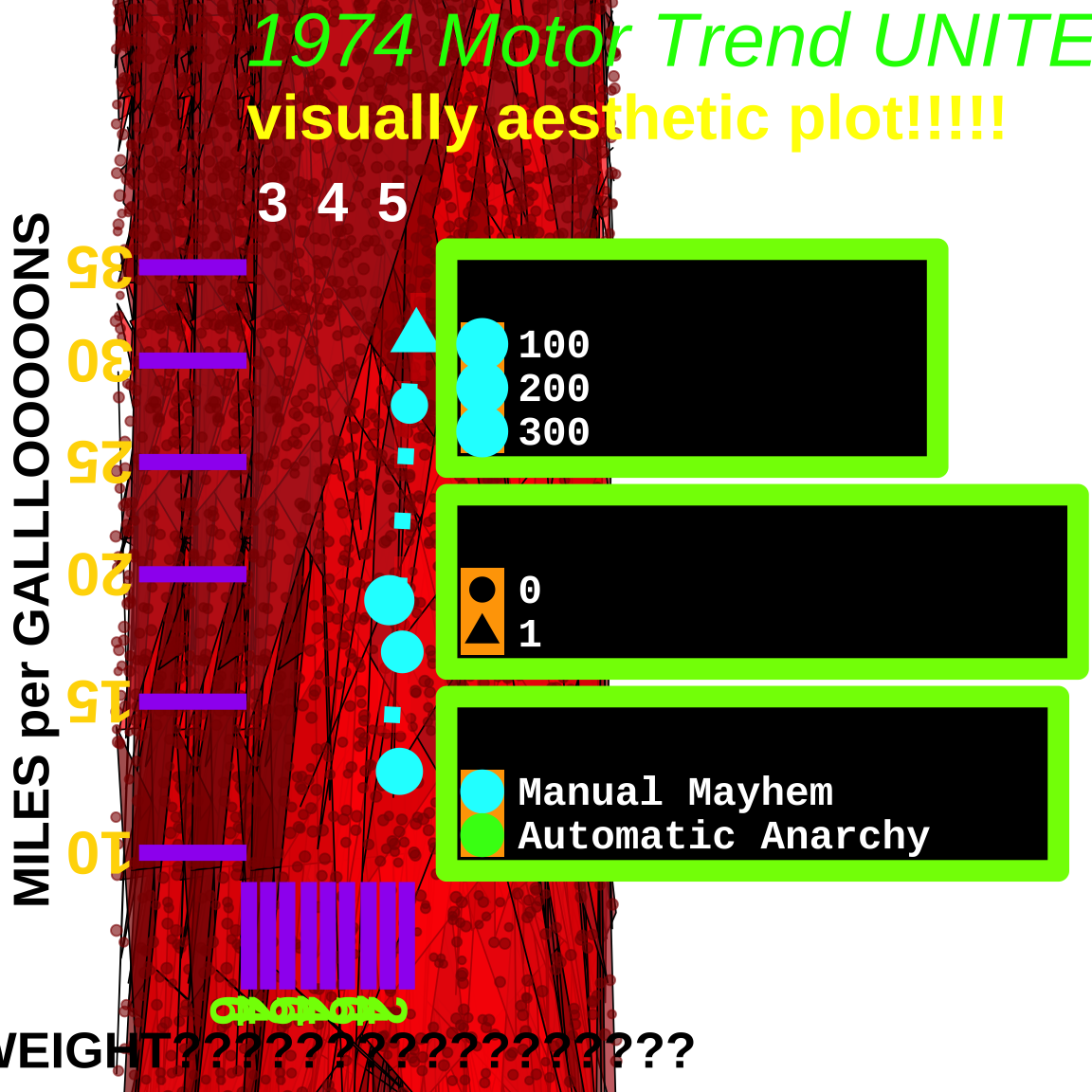
Honorable mention: Lachlan Black

Code
library(showtext)

showtext_auto()

set.seed(1)

bg_dots <- data.frame(
  x = runif(6000, -20, 20),
  y = runif(6000, -50, 100),
  s = runif(6000, 1, 8)
)

bg_poly <- data.frame(
  x = runif(4000, -20, 20),
  y = runif(4000, -50, 100),
  group = rep(1:400, each = 10)
)

bg_poly$fill_col <- rep(
  sample(c("red", "darkred", "firebrick"), 400, replace = TRUE),
  each = 10
)

ggplot(mtcars, aes(x = wt, y = mpg)) +

  # Background polygons
  geom_polygon(
    data = bg_poly,
    aes(x = x, y = y, group = group, fill = fill_col),
    inherit.aes = FALSE,
    alpha = 0.7,
    color = "black",
    linewidth = 0.3,
    show.legend = FALSE
  ) +

  # Background dots
  geom_point(
    data = bg_dots,
    aes(x = x, y = y, size = s),
    inherit.aes = FALSE,
    color = "darkred",
    alpha = 0.6,
    show.legend = FALSE
  ) +

  scale_fill_identity() +

  # Density layer (separate fill scale)
  ggnewscale::new_scale_fill() +

  stat_bin2d(
    bins = 25,
    aes(fill = after_stat(count)),
    alpha = 0.4,
    show.legend = FALSE
  ) +

  scale_fill_gradient(low = "red", high = "darkred") +

  # Real data
  geom_smooth(
    aes(color = factor(am, levels = c(1, 0))),
    se = FALSE,
    method = "lm",
    linetype = "dotted",
    linewidth = 3
  ) +

  geom_jitter(
    aes(
      color = factor(am, levels = c(1, 0)),
      shape = factor(vs),
      size = hp
    ),
    width = 0.7,
    height = 0.7,
    stroke = 5,
    alpha = 1
  ) +

  facet_wrap(~gear) +

  labs(
    title = "1974 Motor Trend UNITED STATES OF THE AMERICAS",
    subtitle = "visually aesthetic plot!!!!!",
    x = "WEIGHT?????????????????",
    y = "MILES per GALLLOOOOONS",
    color = "TRANSMISSION CHAOS",
    shape = "ENGINE OR SOMETHING",
    size = "HORSEPOWER???"
  ) +

  scale_color_manual(
    values = c("cyan", "#39FF14"),
    labels = c("Manual Mayhem", "Automatic Anarchy")
  ) +

  scale_x_reverse() +
  scale_y_continuous(trans = "sqrt") +

  coord_cartesian(
    xlim = c(6, 1),
    ylim = c(35, 10),
    clip = "off"
  ) +

  theme(
    legend.position = "right",
    legend.background = element_rect(
      fill = "black",
      color = "chartreuse",
      linewidth = 4
    ),
    legend.text = element_text(
      family = "mono",
      color = "white",
      size = 16
    ),
    legend.key = element_rect(fill = "orange"),

    text = element_text(
      family = "Comic Sans MS",
      size = 20,
      face = "bold"
    ),

    plot.title = element_text(
      size = 30,
      color = "green",
      face = "italic"
    ),

    plot.subtitle = element_text(
      size = 25,
      color = "yellow"
    ),

    panel.background = element_rect(fill = NA),
    plot.background  = element_rect(fill = NA),
    strip.background = element_rect(fill = NA),

    strip.text = element_text(
      size = 22,
      color = "white",
      face = "bold"
    ),

    panel.grid.major = element_line(
      color = "yellow",
      linewidth = 3,
      linetype = "dotdash"
    ),

    panel.grid.minor = element_line(
      color = "white",
      linewidth = 2
    ),

    axis.text.x = element_text(
      angle = 270,
      color = "chartreuse",
      size = 22
    ),

    axis.text.y = element_text(
      angle = 180,
      color = "gold",
      size = 24
    ),

    axis.ticks = element_line(
      linewidth = 3,
      color = "purple"
    ),

    axis.ticks.length = unit(1.5, "cm"),

    panel.spacing = unit(0.1, "cm")
  ) +

  guides(
    size = guide_legend(
      override.aes = list(
        color = "cyan",
        fill = "cyan1",
        alpha = 1,
        size = 3
      )
    )
  )

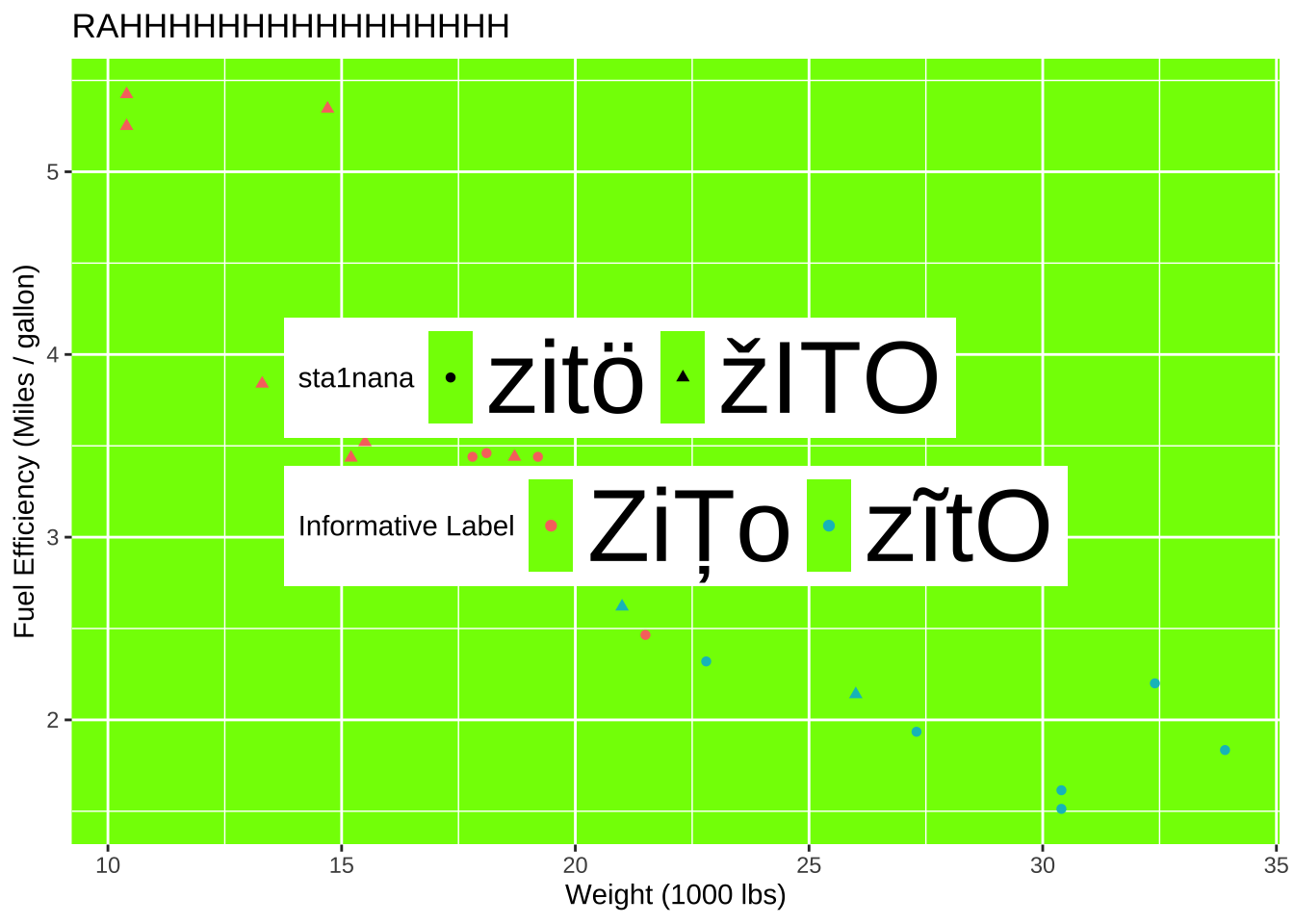
Honorable mentschen: Nicholas Wang

Code
mtcars |> 
  mutate(
    am = case_when(
      am == 0 ~"ZiȚo",
      am == 1 ~ "zĩtO"
    ),
    am = fct_relevel(am, "Manual"),
    vs = case_when(
      vs == 0 ~ "žITO",
      vs == 1 ~ "zitö"
    )
  ) |> 
  ggplot(
    aes(y = wt, 
        x = mpg, 
        color = am)) +
    geom_point(
      aes(shape = vs)
    ) +
    labs(
      x = "Weight (1000 lbs)",
      y = "Fuel Efficiency (Miles / gallon)",
      title = "RAHHHHHHHHHHHHHHHH",
      color = "Informative Label",
      shape = "sta1nana"
    ) +
    theme(legend.position = c(0.5,0.5),
          legend.text = element_text(size = 40),
          legend.direction = "horizontal",
          panel.background = element_rect(fill = "chartreuse"))

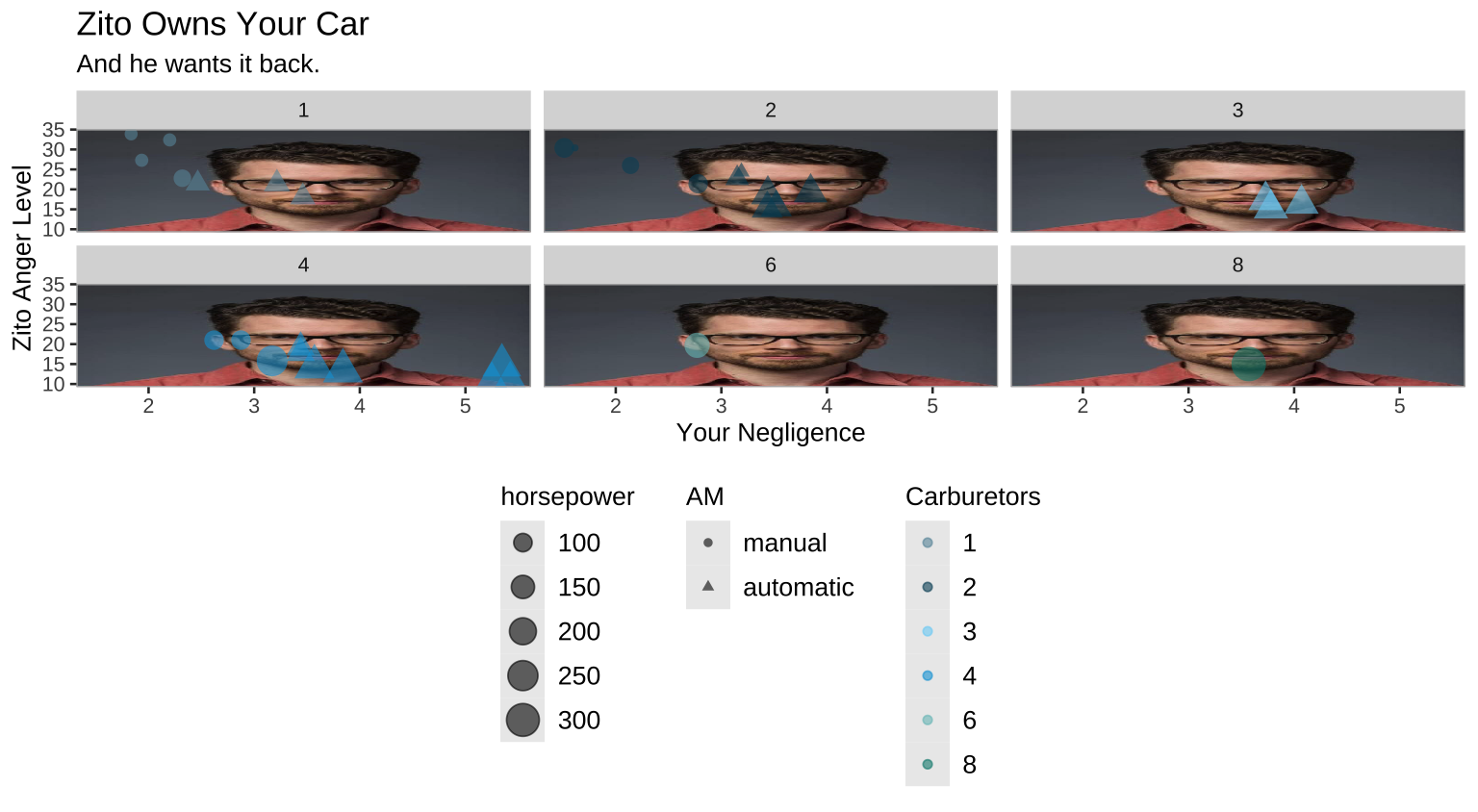
Honorable mentschen: Zachary Hyman

Code
library(jpeg)
library(grid)

mt_clean <- mtcars |> 
  mutate(
    am = if_else(am == 0, "automatic", "manual"),
    am = fct_relevel(am, "manual", "automatic")
  )

jcz_file <- "images/13/jcz.jpg" 
image_data <- jpeg::readJPEG(jcz_file)
grob_image <- rasterGrob(image_data, width = unit(1, "npc"), 
                         height = unit(1, "npc"), interpolate = FALSE)

ggplot(mt_clean, aes(x = wt, y = mpg, color = factor(carb), 
                     shape = am, size = hp)) +
  annotation_custom(grob_image, xmin = -Inf, xmax = Inf, ymin = -Inf, 
                    ymax = Inf) +
  geom_point(alpha = 0.6) +
  labs(
    x = "Your Negligence",
    y = "Zito Anger Level",
    color = "Carburetors",
    shape = "AM",
    size = "horsepower",
    title = "Zito Owns Your Car",
    subtitle = "And he wants it back."
  ) +
  theme_calc() +
  theme(
    legend.position = "bottom"
  ) +
  facet_wrap(~ carb) +
  scale_color_economist() 

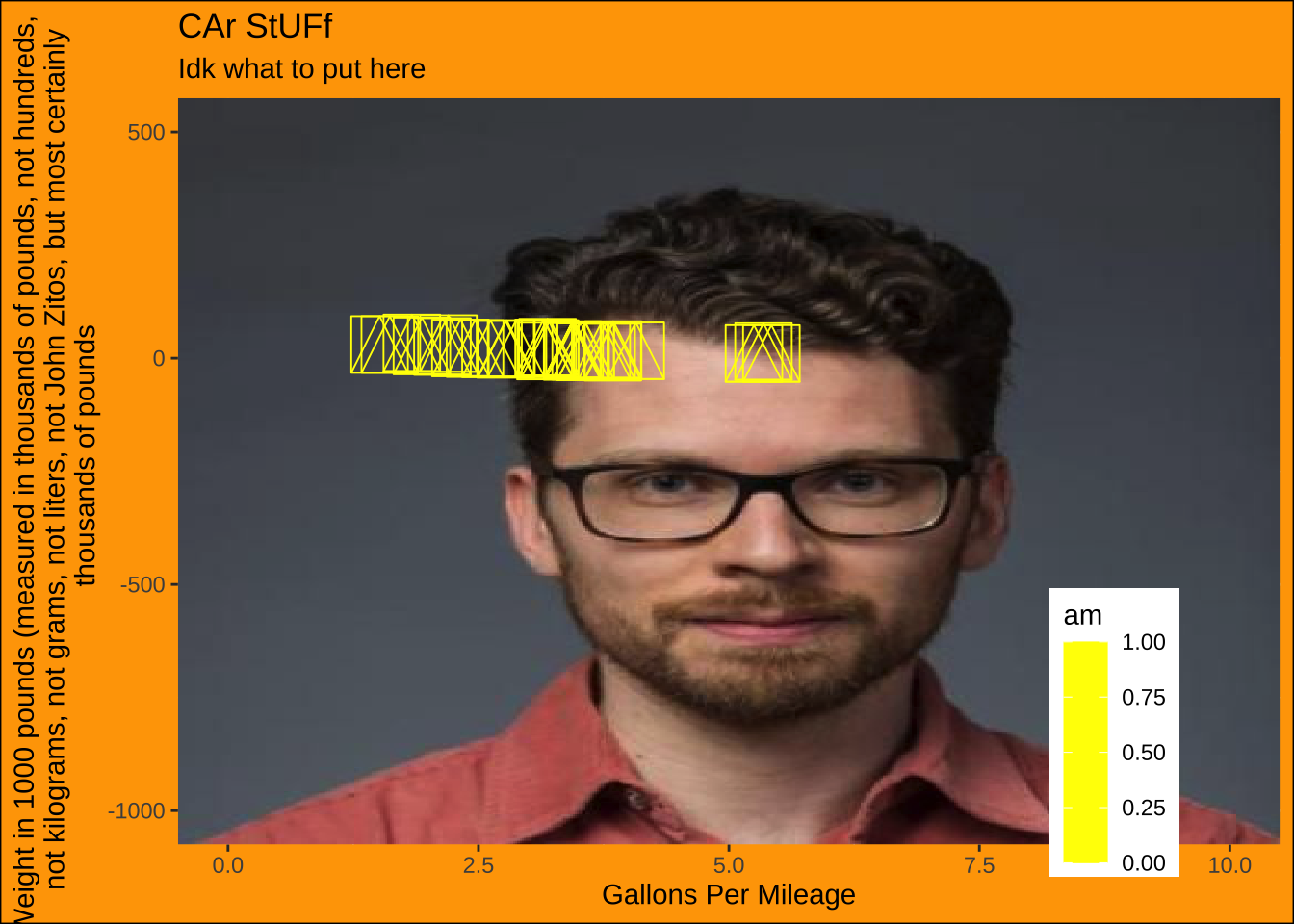
Honorable mentschen: Parker Upton

Code
library(jpeg)

mtcars_categorical <- mtcars |>
  mutate(
    transmission = case_when(
      am == 0 ~ "Automatic",
      am == 1 ~ "Manual"
    ),
      engine = case_when(
        vs == 0 ~ "V-shaped",
        vs == 1 ~ "straight"
      )
  )

url <- "https://scholars.duke.edu/profile-images/thumbnail500/0935990.jpg"
tmp <- tempfile(fileext = ".jpg")

download.file(url, tmp, mode = "wb")
img <- readJPEG(tmp)

ggplot(mtcars_categorical, 
       aes(x = wt, y = mpg, color = am)) +
  annotation_raster(
    img,
    xmin = -Inf, xmax = Inf,
    ymin = -Inf, ymax = Inf
  ) +
  geom_point(size = 10, shape = 14) +
  scale_color_gradient(low = "yellow", high = "yellow") +
  labs(
    x = "Gallons Per Mileage",
    y = "Weight in 1000 pounds (measured in thousands of pounds, not hundreds, 
    not kilograms, not grams, not liters, not John Zitos, but most certainly 
    thousands of pounds",
    title = "CAr StUFf",
    subtitle = "Idk what to put here"
  ) +
  coord_cartesian(xlim = c(0, 10), ylim = c(-1000, 500)) +
  theme(
    panel.background = element_rect(fill = "black"),
    plot.background = element_rect(fill = "orange", color = "black"),
    legend.position = c(0.85, 0.15)
  )

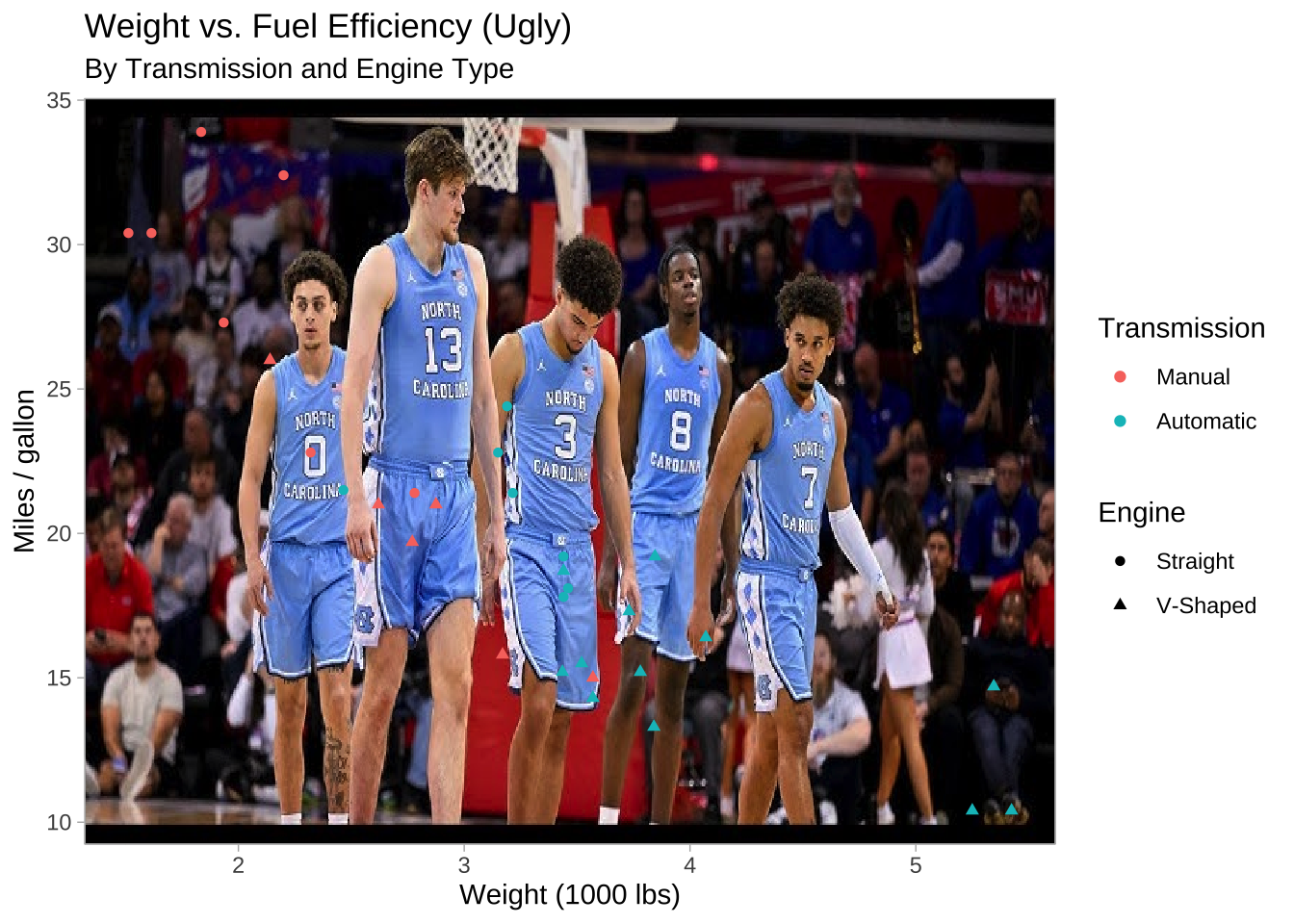
Third place: Henry O’Hara

“I know we are supposed to make 5 changes to the graph, but one main one was really all I needed. No need to explain why it’s ugly.”

Code
#I used Google Gemini 3 to show me how to make the image the background.
#The date was 2.15.26
#The link was https://gemini.google.com/share/baddfa4f4e0e

library(magick)
library(ggpubr)

unc_url <- "https://i.ytimg.com/vi/QGUKD_UgSmE/hq720.jpg?sqp=-oaymwEhCK4FEIIDSFryq4qpAxMIARUAAAAAGAElAADIQj0AgKJD&rs=AOn4CLADGSk5U3I0StJLmaxqeBIdd4AE-w"
unc_img <- magick::image_read(unc_url)

mtcars |> 
  mutate(am = factor(am, levels = c(1,0), 
                     labels = c("Manual", "Automatic")),
         vs = factor(vs, levels = c(1,0),
                     labels = c("Straight", "V-Shaped"))
         ) |> 
  ggplot(aes(x = wt, y = mpg, color = am, shape = vs)) +
  background_image(unc_img) +
  geom_point() +
  labs(
    x = "Weight (1000 lbs)",
    y = "Miles / gallon",
    color = "Transmission",
    shape = "Engine",
    title = "Weight vs. Fuel Efficiency (Ugly)",
    subtitle = "By Transmission and Engine Type"
  ) + 
  theme_light() +
  theme(legend.position = "right")

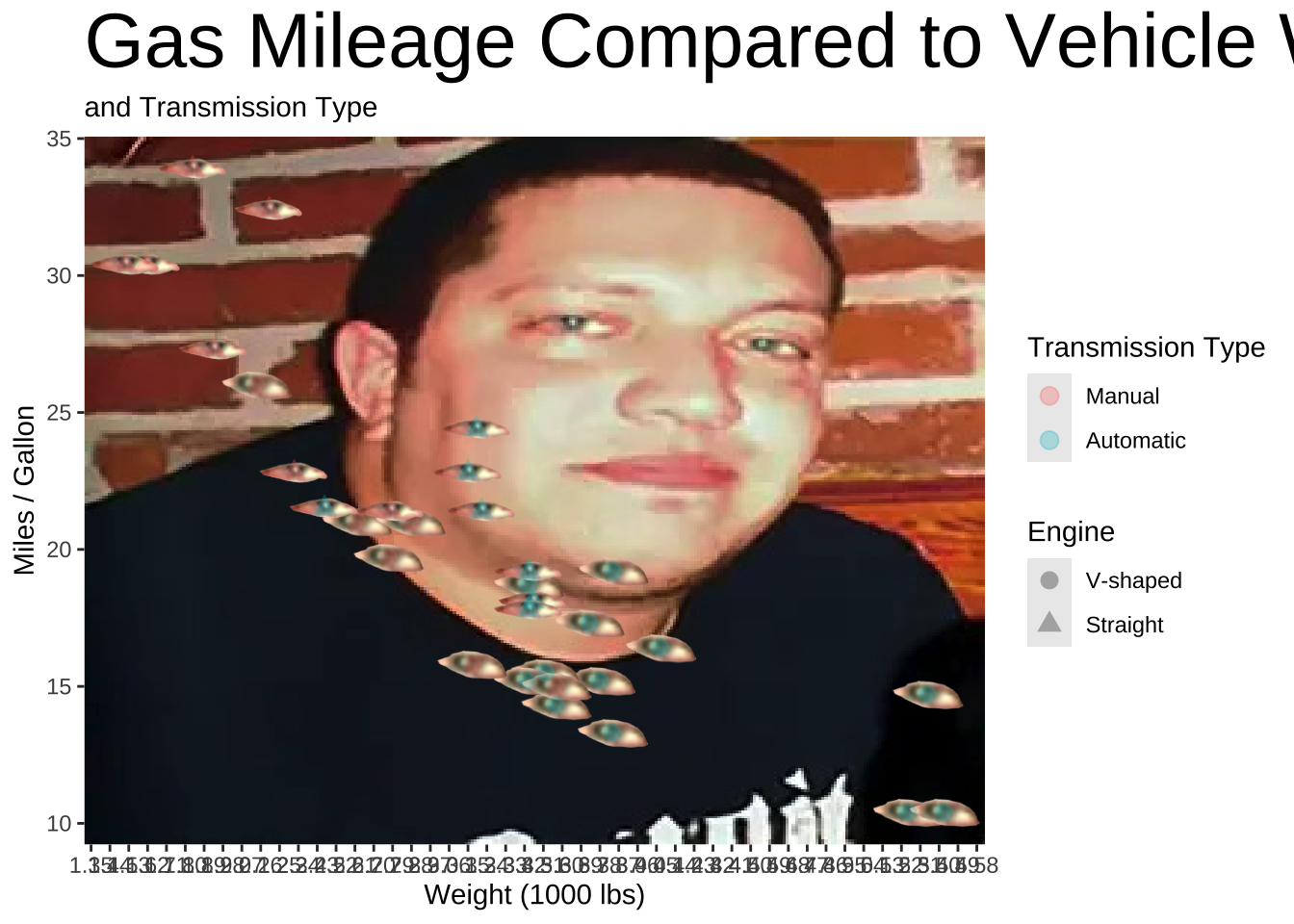
First place: Sammy Ciuni

Code
library(jpeg)
library(png)
library(ggimage)
library(ggpubr)
library(systemfonts)

long_live_sal <- readJPEG("images/13/download.jpg")
left_eye <- "images/13/left-eye.png"
right_eye <- "images/13/right-eye.png"

mtcars |>
  mutate(am = case_when(
      am == 1 ~ "Manual", 
      .default = "Automatic"),
    vs = case_when(
      vs == 1 ~ "Straight", 
      .default = "V-shaped"),
    img = if_else(
      vs == "Straight", left_eye, right_eye
     )) |>
ggplot(aes(x = wt, 
           y = mpg,
           shape = factor(vs))) +
  background_image(long_live_sal) +
  geom_image(aes(
    image = img), size = 0.1) +
  geom_point(aes(color = am), size = 3, alpha = 0.3) +
  labs(
    x = "Weight (1000 lbs)",
    y = "Miles / Gallon",
    color = "Transmission Type",
    shape = "Engine",
    title = "Gas Mileage Compared to Vehicle Weight",
    subtitle = "and Transmission Type"
  ) +
  scale_x_continuous(breaks = seq(0, 6, 0.09)) +
  scale_color_discrete(limits = c("Manual", "Automatic")) +
  scale_shape_discrete(limits = c("V-shaped", "Straight")) +
  theme(legend.position = "right",
        plot.title = element_text(size = 30))

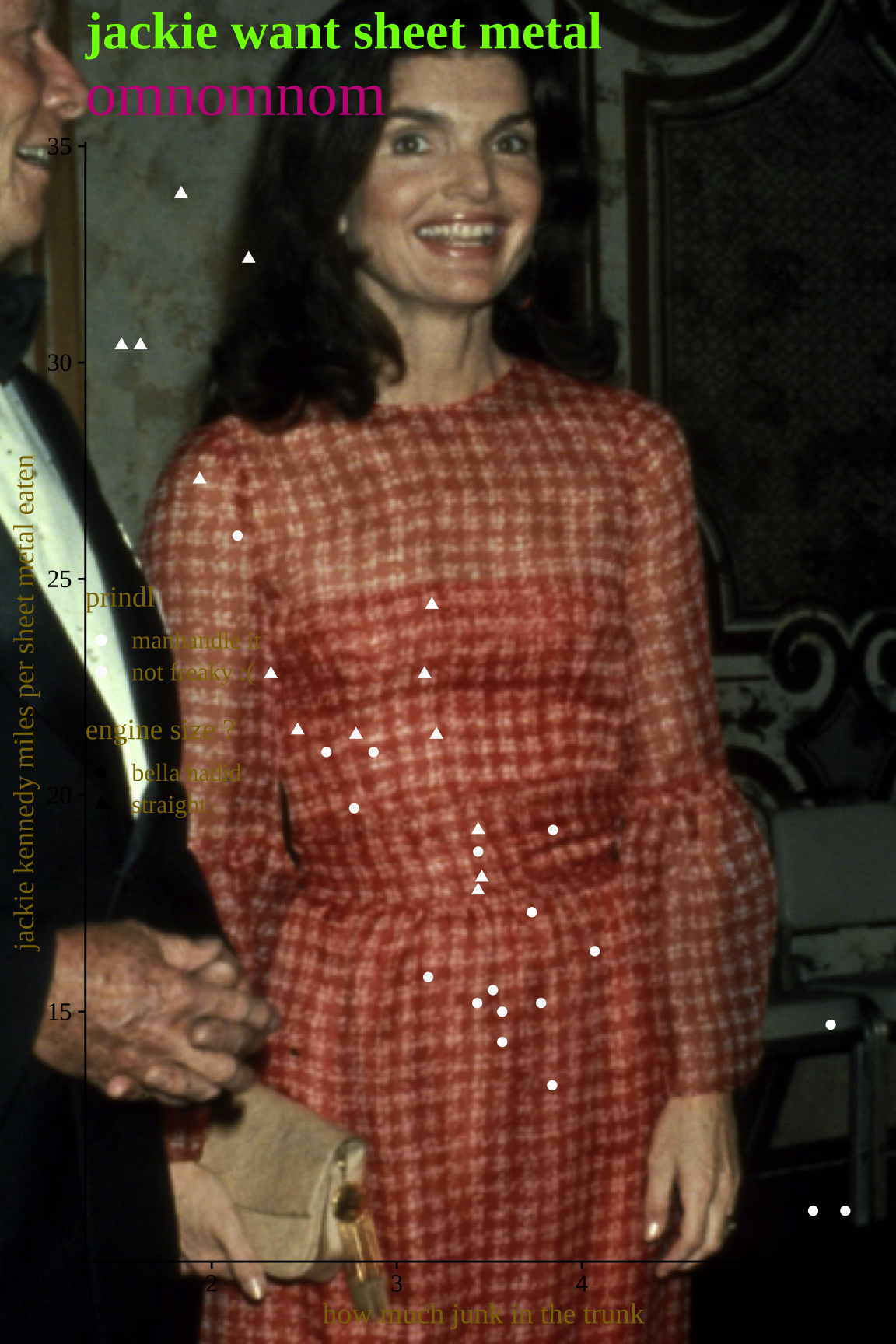
First place: Austin Rios

Know Your Meme.

Code
library(png)
library(cowplot)
library(magick)

jackie_photo <- readPNG("images/13/jackie_o.png")

theme_set(theme_cowplot())

bad_graph <- mtcars |> 
  mutate(am = if_else(am == 0, "manhandle it", "not freaky :("),
         am = fct_relevel(am, "manhandle it", "not freaky :("), 
         vs = if_else(vs == 0, "bella hadid", "straight")
         ) |> 
  ggplot(aes(x = wt, y = mpg, color = am, shape = vs)) +
  geom_point(alpha = 1) +
  theme(legend.position = "inside",
        plot.title = element_text(size = 25, color = "lawngreen"),
        plot.subtitle = element_text(size = 30, color = "mediumvioletred"),
       # plot.background = element_rect(fill = "yellow3"),
        text = element_text(color = "gold4", family = "serif")
        ) + 
  scale_color_manual(values = c("manhandle it" = "gray99", 
                               "not freaky :(" = "gray98")) + 
  labs(
    x = "how much junk in the trunk",
    y = "jackie kennedy miles per sheet metal eaten", 
    title = "jackie want sheet metal",
    subtitle = "omnomnom", 
    color = "prindl",
    shape = "engine size ?"
  )

ggdraw() +
  draw_image(jackie_photo, scale = 1.2) + 
  draw_plot(bad_graph)

Project

The bottom line, at the top

  • Write an in-depth article that might appear in the popular press (NYT, Chronicle, etc);
  • Audience: intelligent but non-technical reader that is unfamiliar with the domain;
  • Emphasize clear communication, attractive and informative graphics, and carefully chosen numerical summaries;
  • R code and raw output should not appear;
  • All figures and tables should be labeled with captions.

Telling a story

Setup

library(tidyverse)
library(tidymodels)
library(ggrepel)
library(ggthemes)
library(palmerpenguins)

Multiple ways of telling a story

  • Sequential reveal: Motivation, then resolution

  • Instant reveal: Resolution, and hidden in it motivation

Simplicity vs. complexity

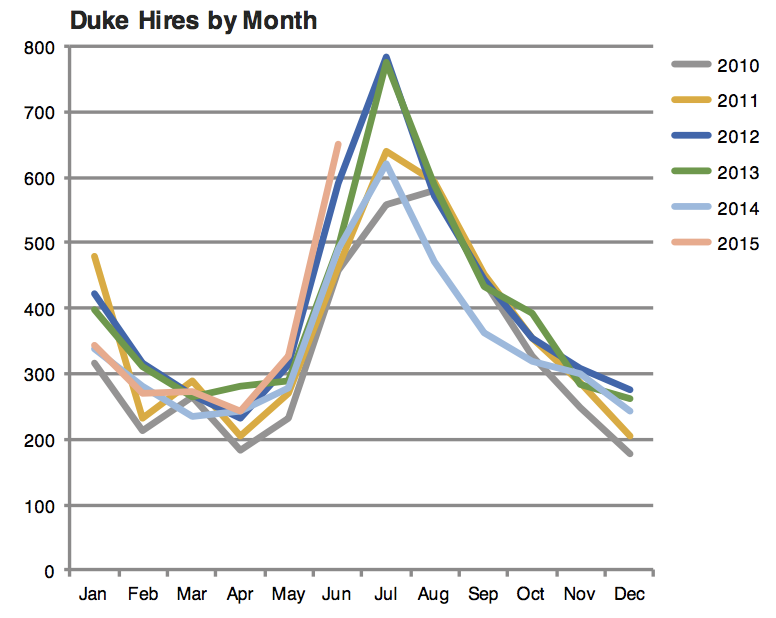
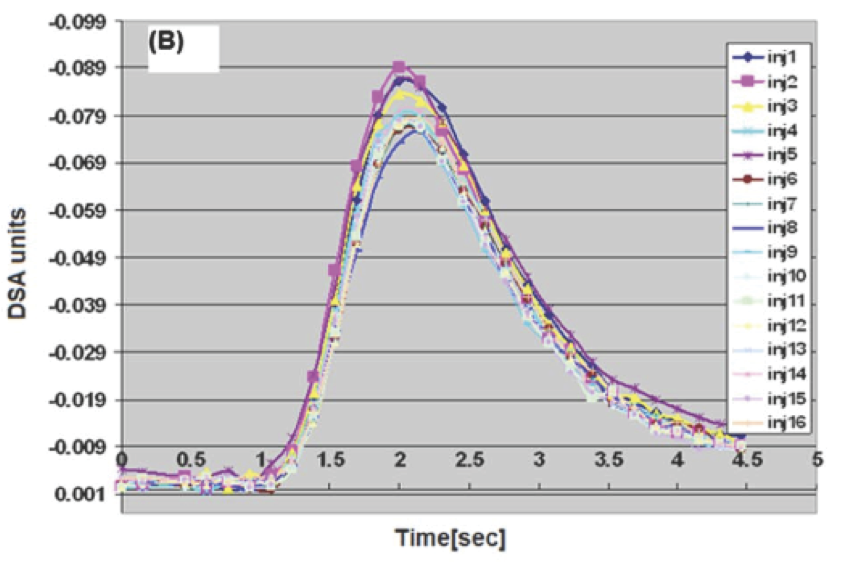
When you’re trying to show too much data at once you may end up not showing anything.

  • Never assume your audience can rapidly process complex visual displays

  • Don’t add variables to your plot that are tangential to your story

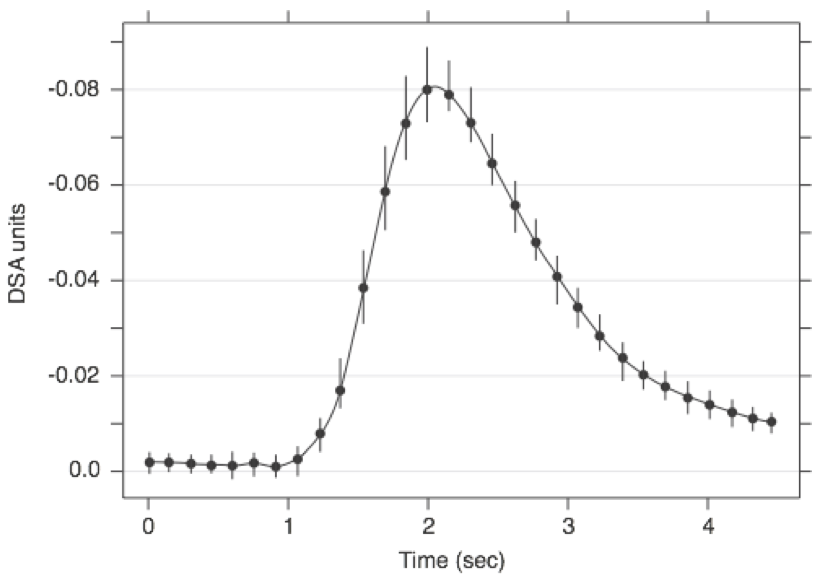
  • Don’t jump straight to a highly complex figure; first show an easily digestible subset (e.g., show one facet first)

  • Aim for memorable, but clear

Project note: Make sure to leave time to iterate on your plots after you practice your presentation. If certain plots or outputs are getting too wordy to explain, take time to simplify them!

Consistency vs. repetitiveness

Be consistent but don’t be repetitive.

  • Use consistent features throughout plots (e.g., same color represents same level on all plots)

  • Aim to use a different type of summary or visualization for each distinct analysis

Project note: If possible, ask a friend who is not in the class to listen to your presentation and then ask them what they remember. Then, ask yourself: is that what you wanted them to remember?

Participate 📱💻

When you read an article, which style do you prefer?

  • Sequential reveal

  • Instant reveal

  • neither

Scan the QR code or go HERE. Log in with your Duke NetID.

Designing effective visualizations

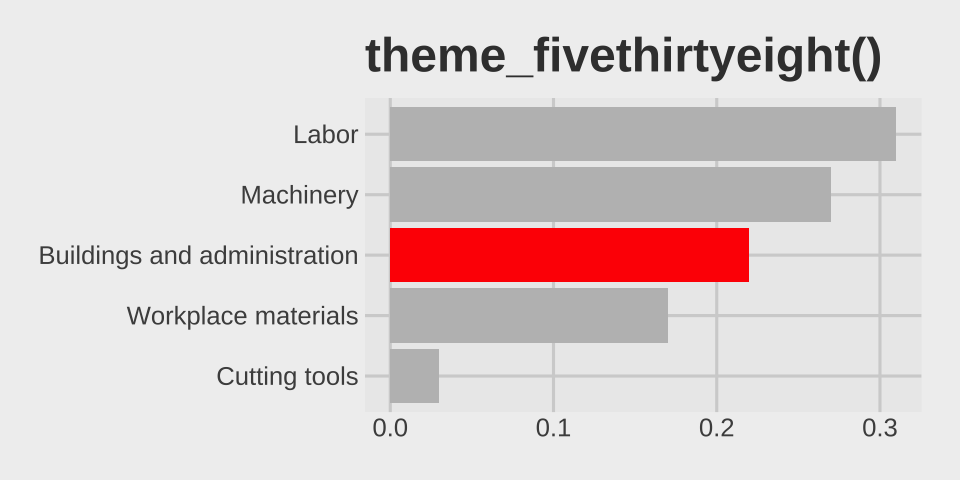
Data

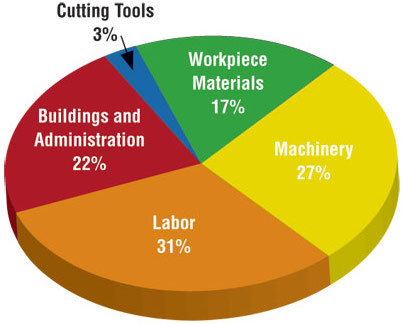
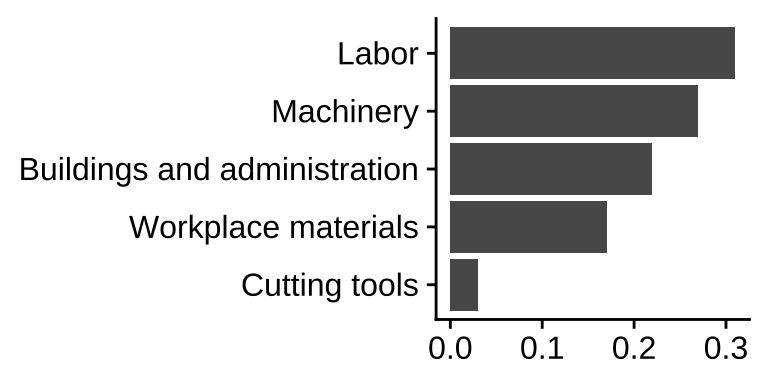
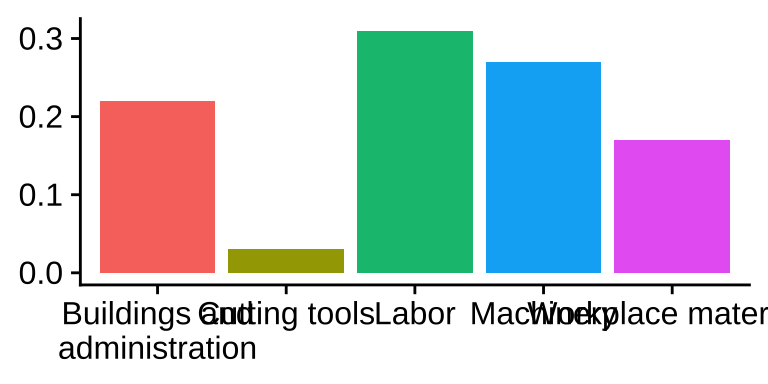
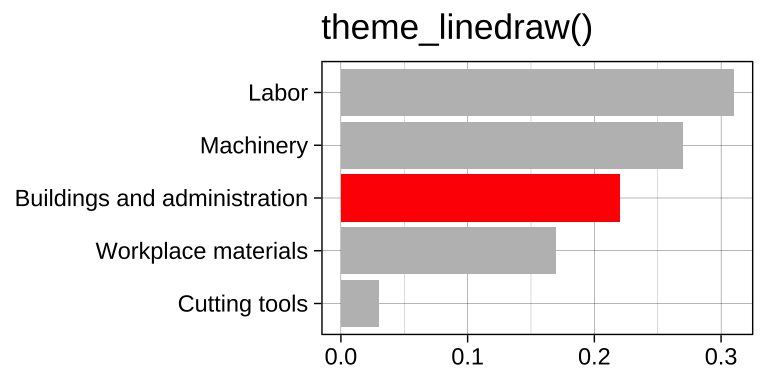
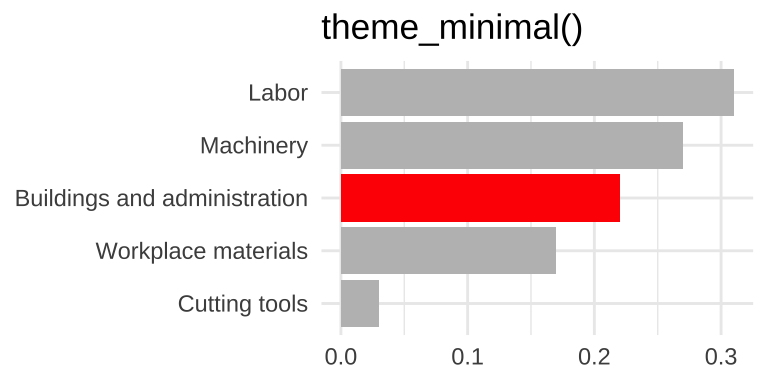
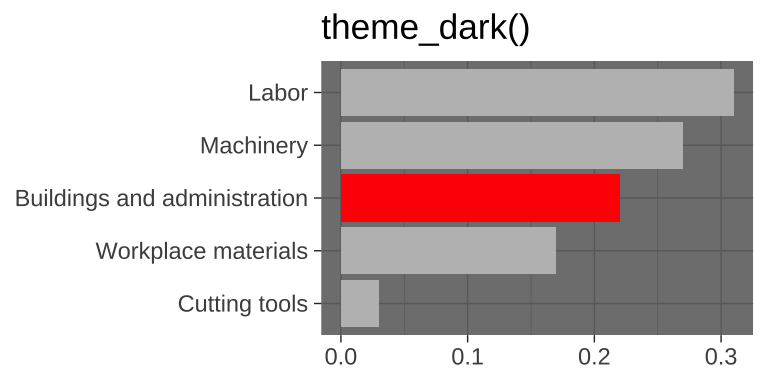
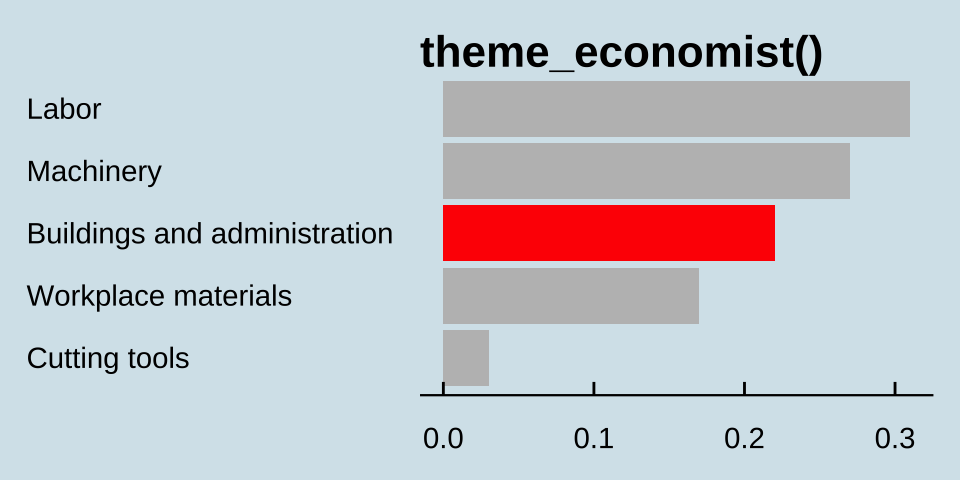
d <- tribble(
  ~category,                     ~value,
  "Cutting tools"                , 0.03,
  "Buildings and administration" , 0.22,
  "Labor"                        , 0.31,
  "Machinery"                    , 0.27,
  "Workplace materials"          , 0.17
)
d
# A tibble: 5 × 2
  category                     value
  <chr>                        <dbl>
1 Cutting tools                 0.03
2 Buildings and administration  0.22
3 Labor                         0.31
4 Machinery                     0.27
5 Workplace materials           0.17

Keep it simple

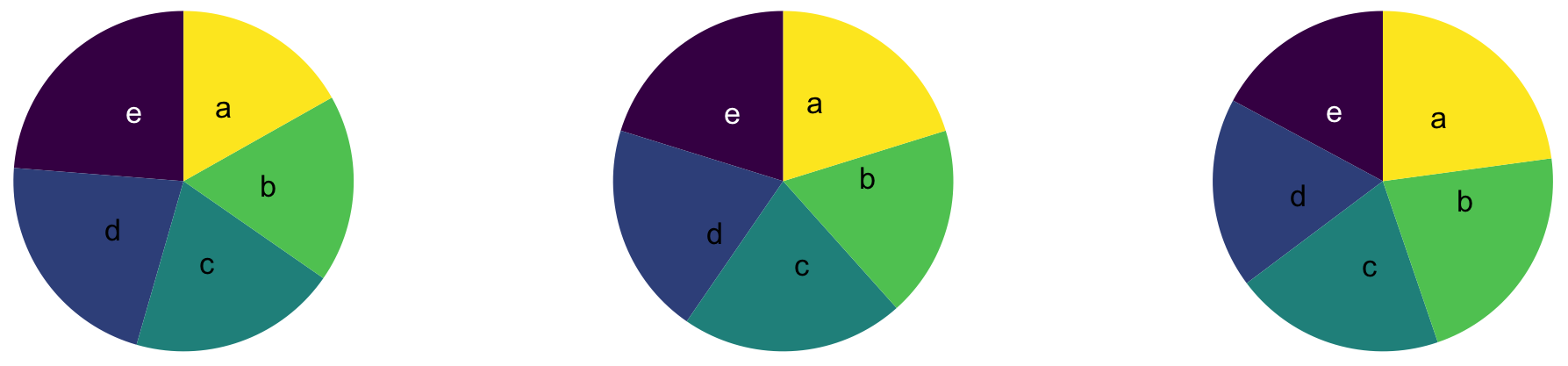
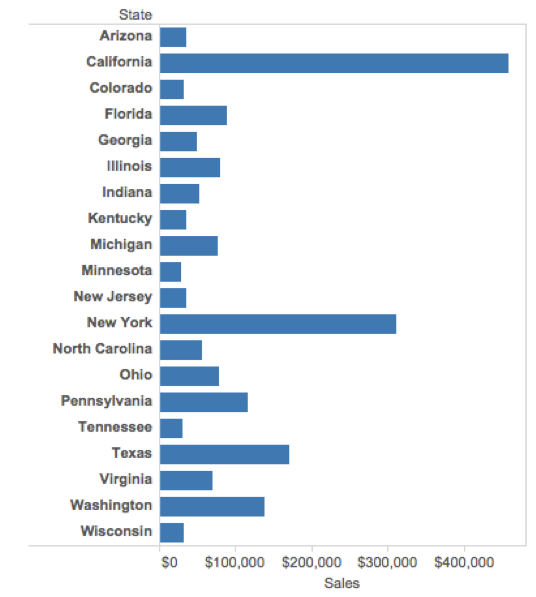
Judging relative area

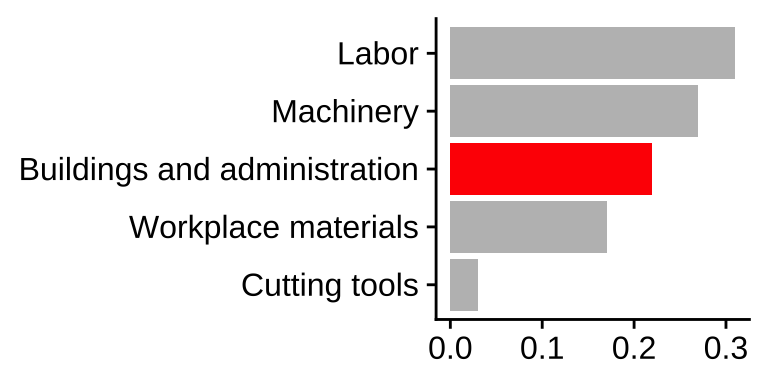
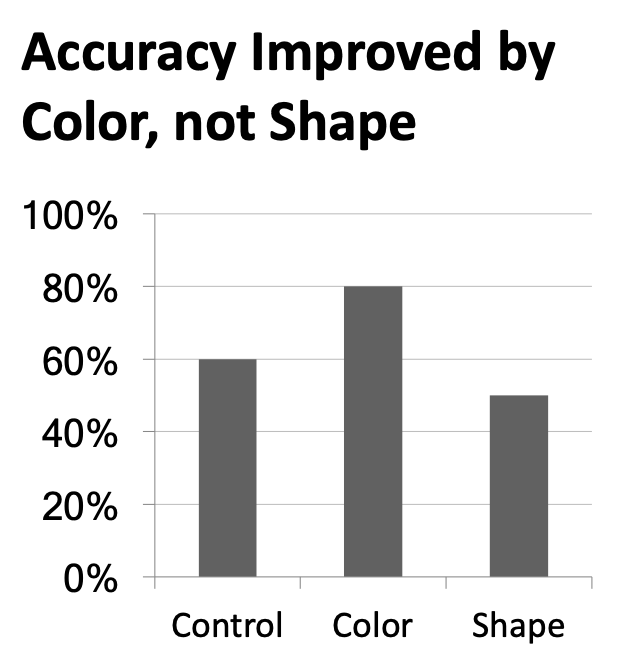
Use color to draw attention


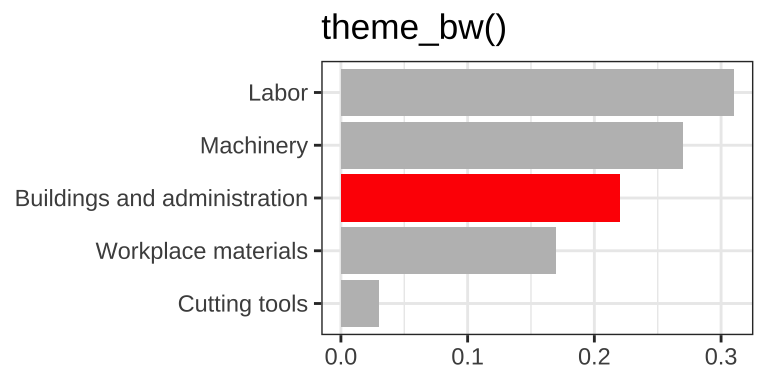
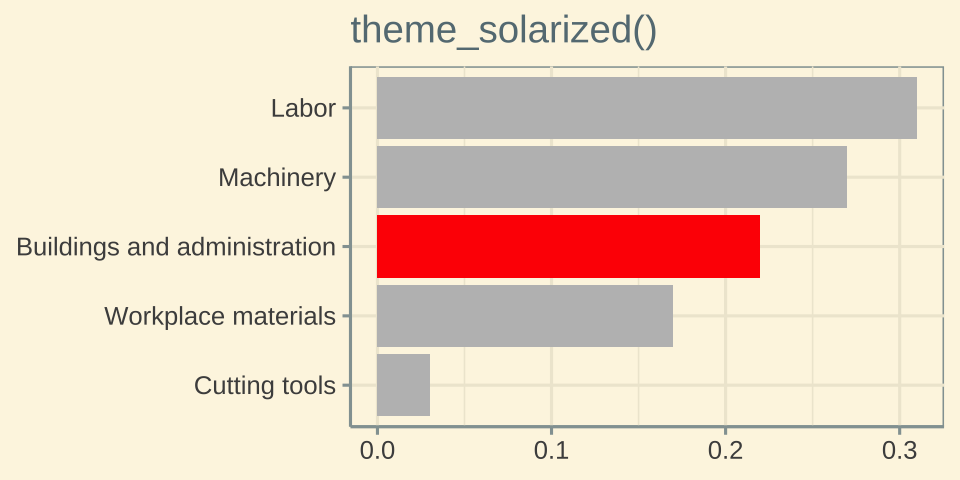
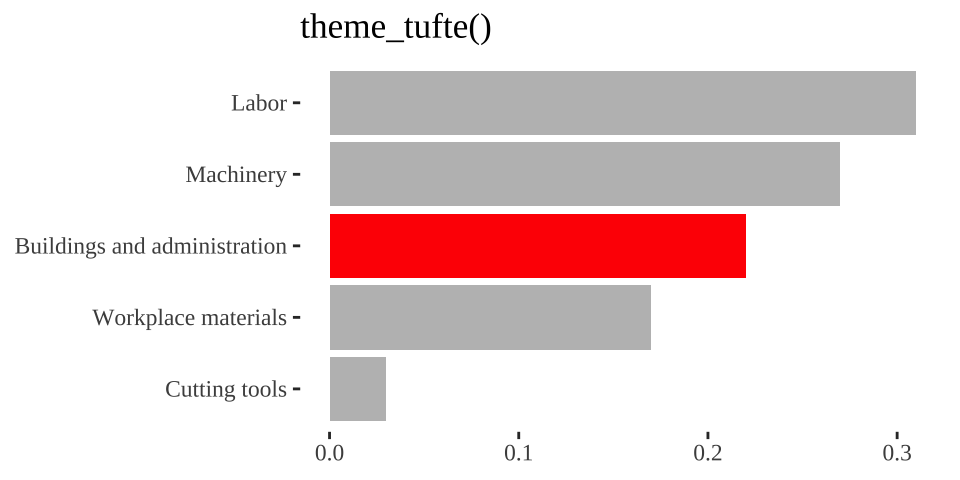
Play with themes for a non-standard look

Go beyond ggplot2 themes – ggthemes

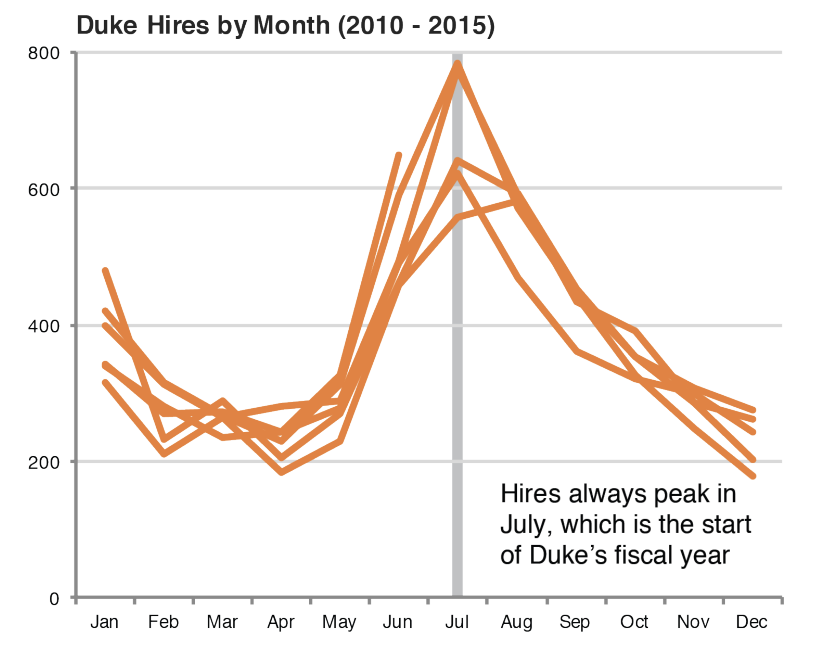
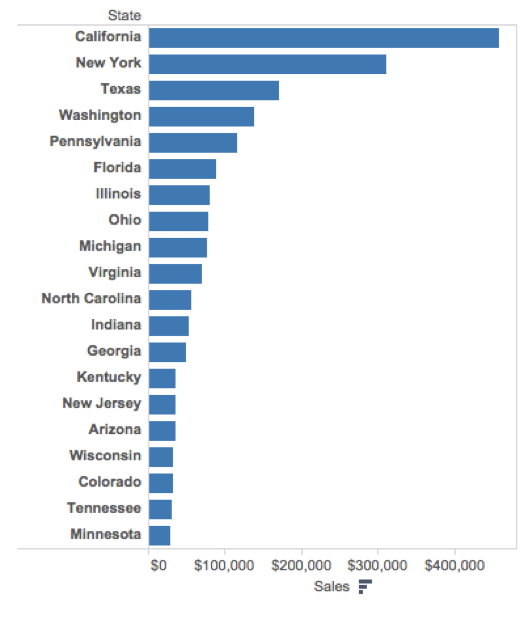
Tell a story

Leave out non-story details

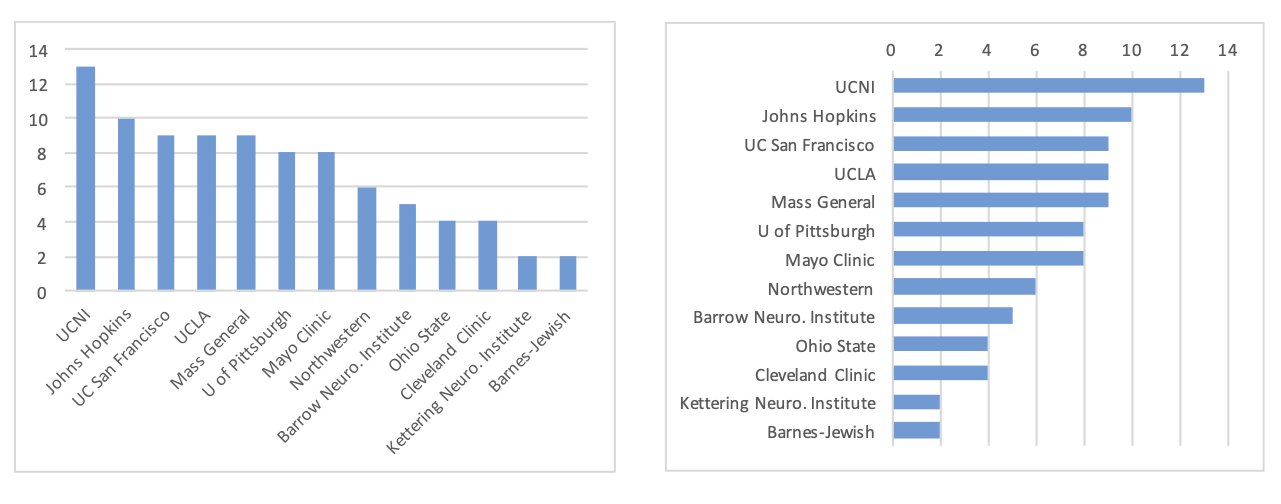
Order matters

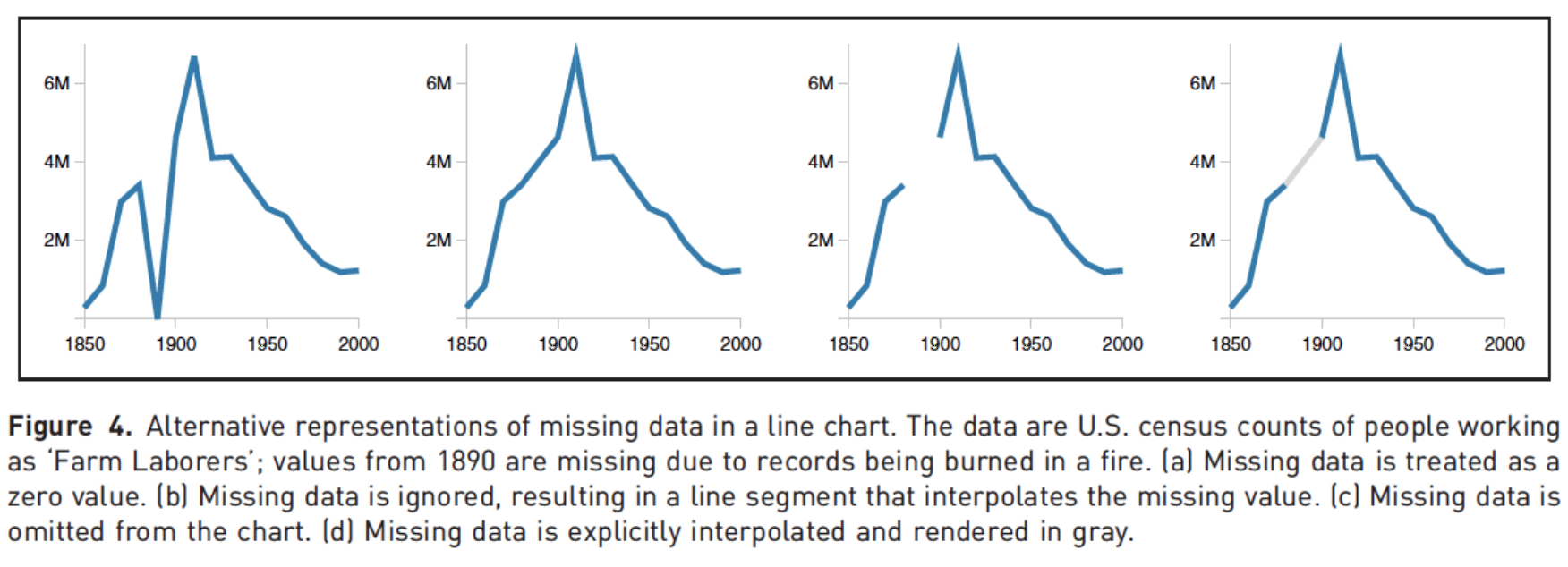
Clearly indicate missing data

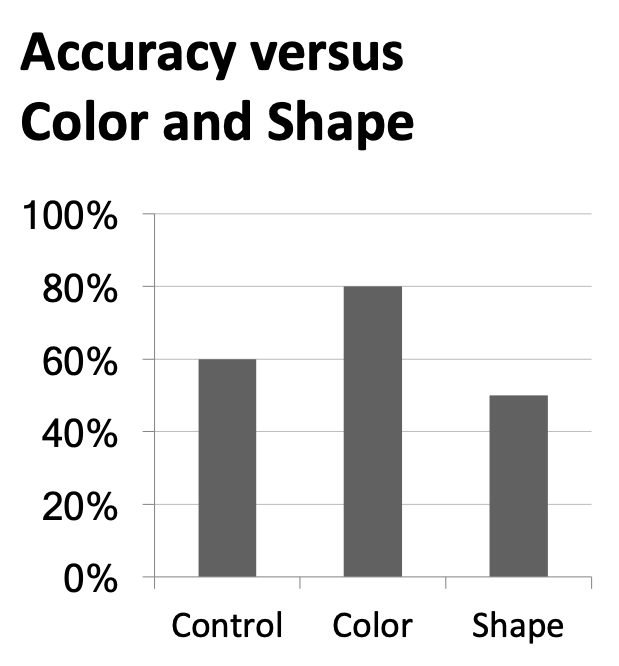
Reduce cognitive load

Use descriptive titles

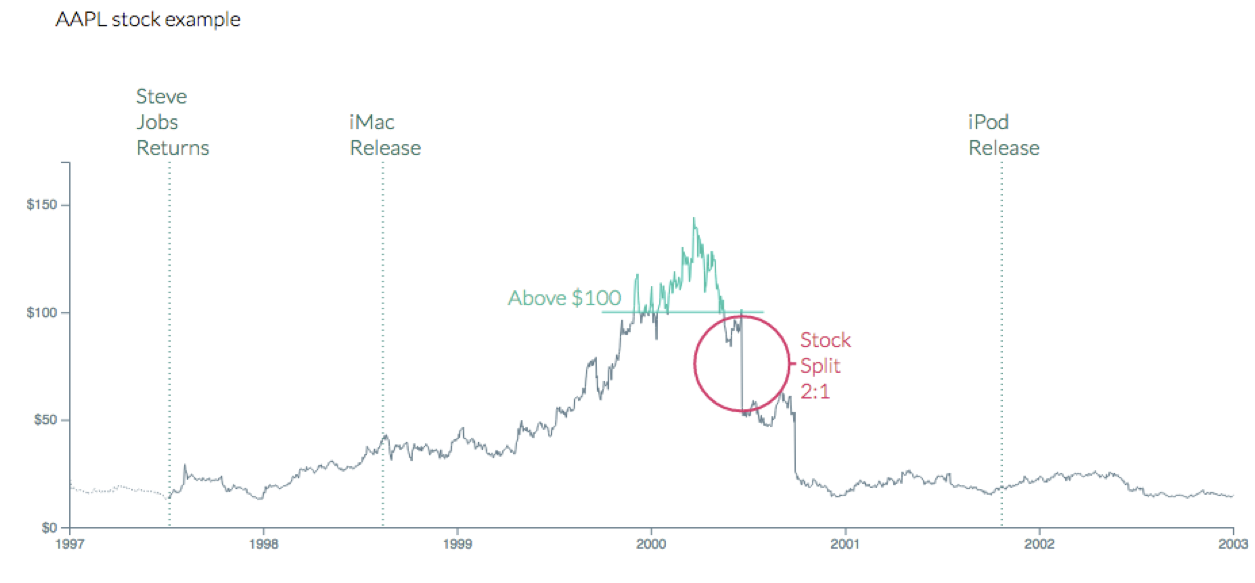
Annotate figures

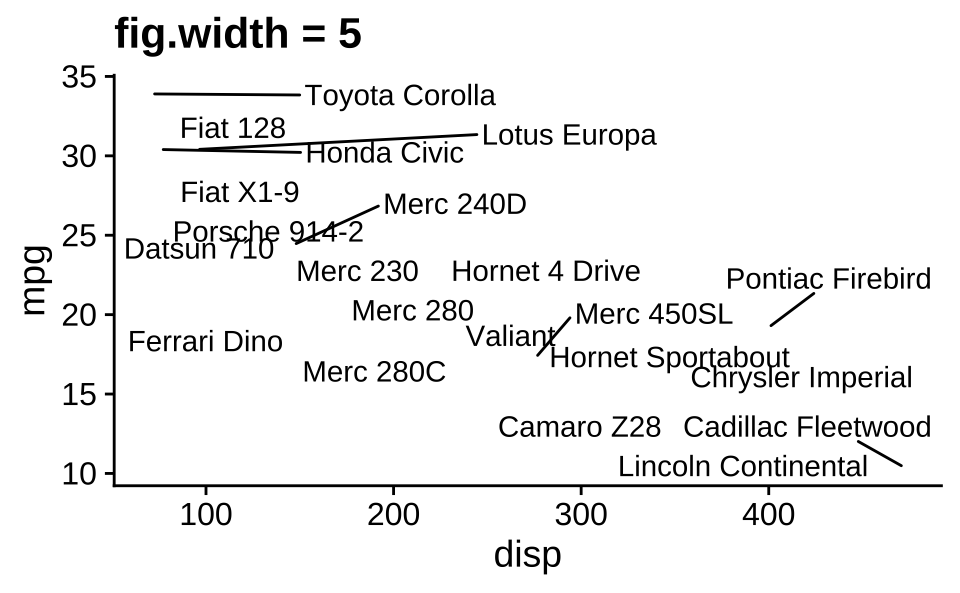
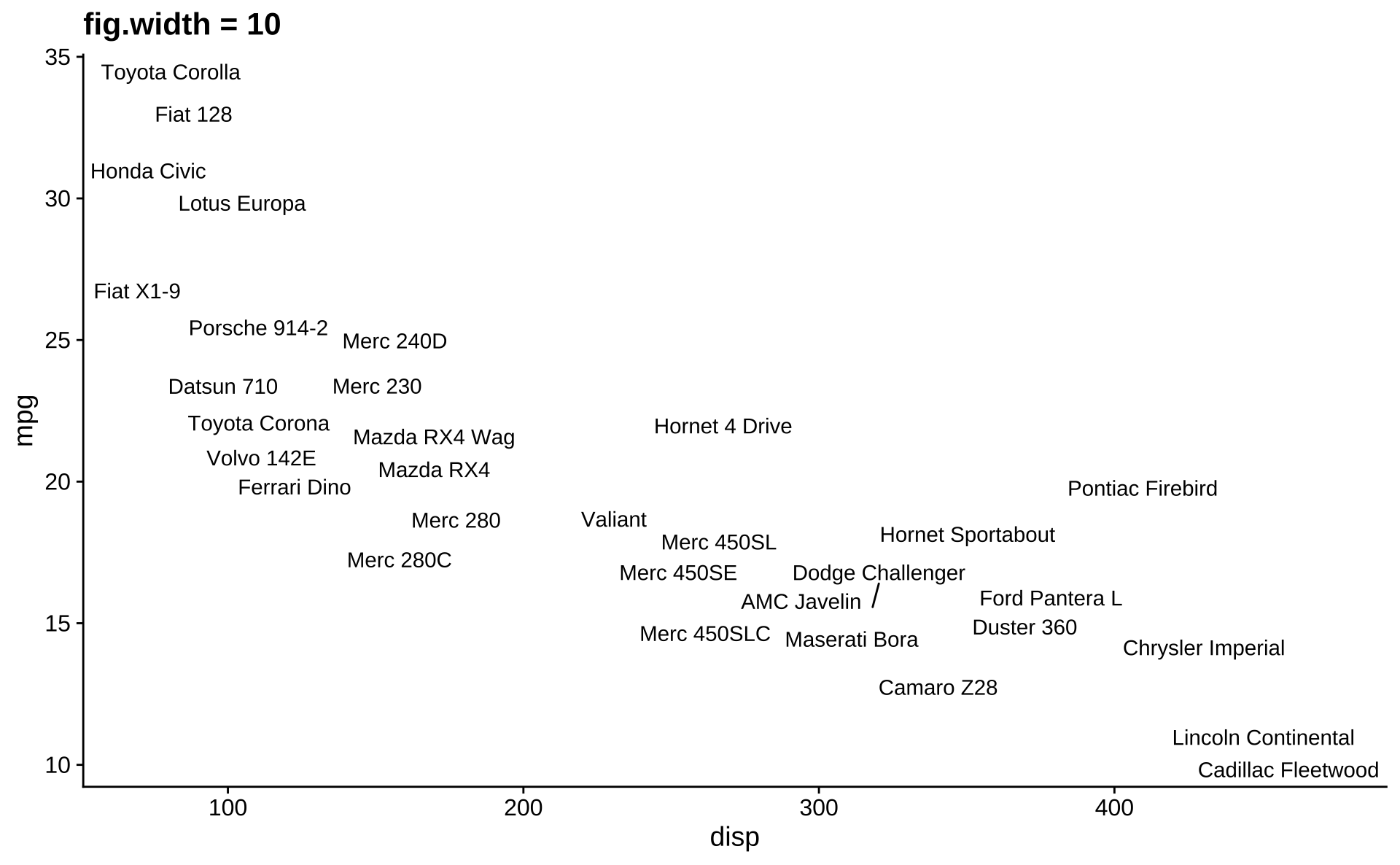
Plot sizing and layout

Sample plots

p_hist <- ggplot(mtcars, aes(x = mpg)) +
  geom_histogram(binwidth = 2)

p_text <- mtcars |>
  rownames_to_column() |>
  ggplot(aes(x = disp, y = mpg)) +
  geom_text_repel(aes(label = rowname)) +
  coord_cartesian(clip = "off")

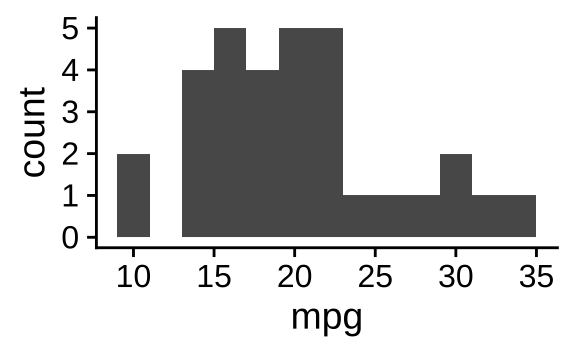
Small fig-width

For a zoomed-in look

```{r}
#| fig-width: 3
#| fig-asp: 0.618

p_hist
```

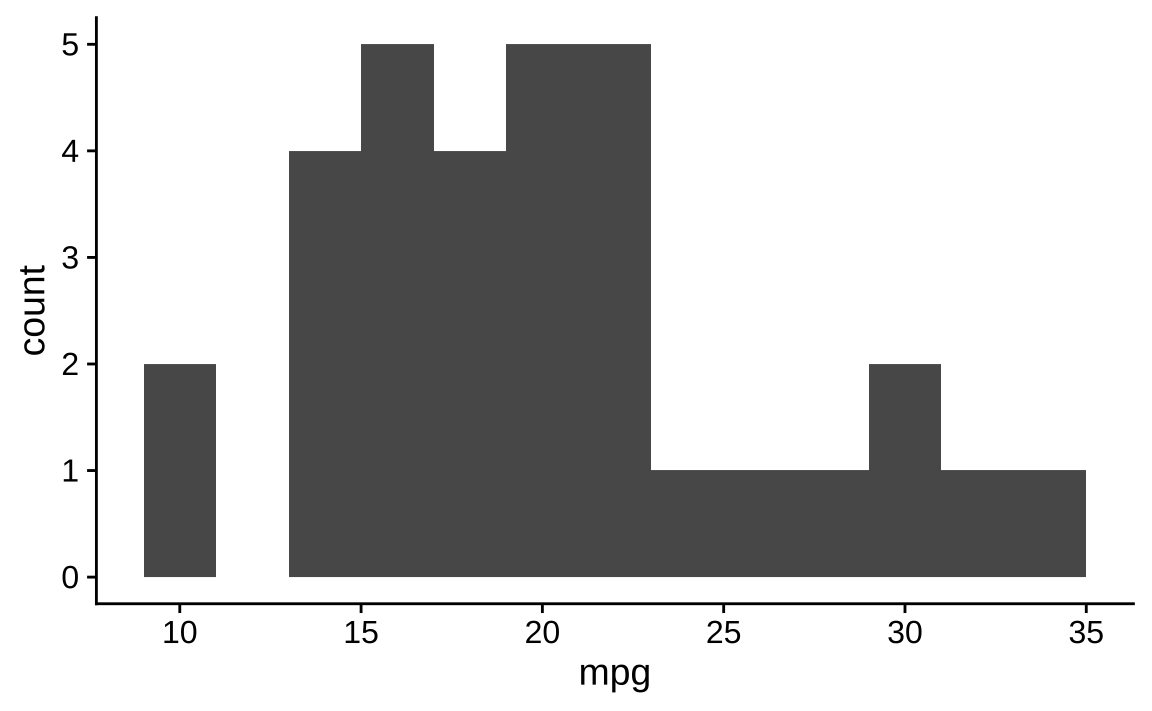
Large fig-width

For a zoomed-out look

```{r}
#| fig-width: 6
#| fig-asp: 0.618

p_hist
```

fig-width affects text size

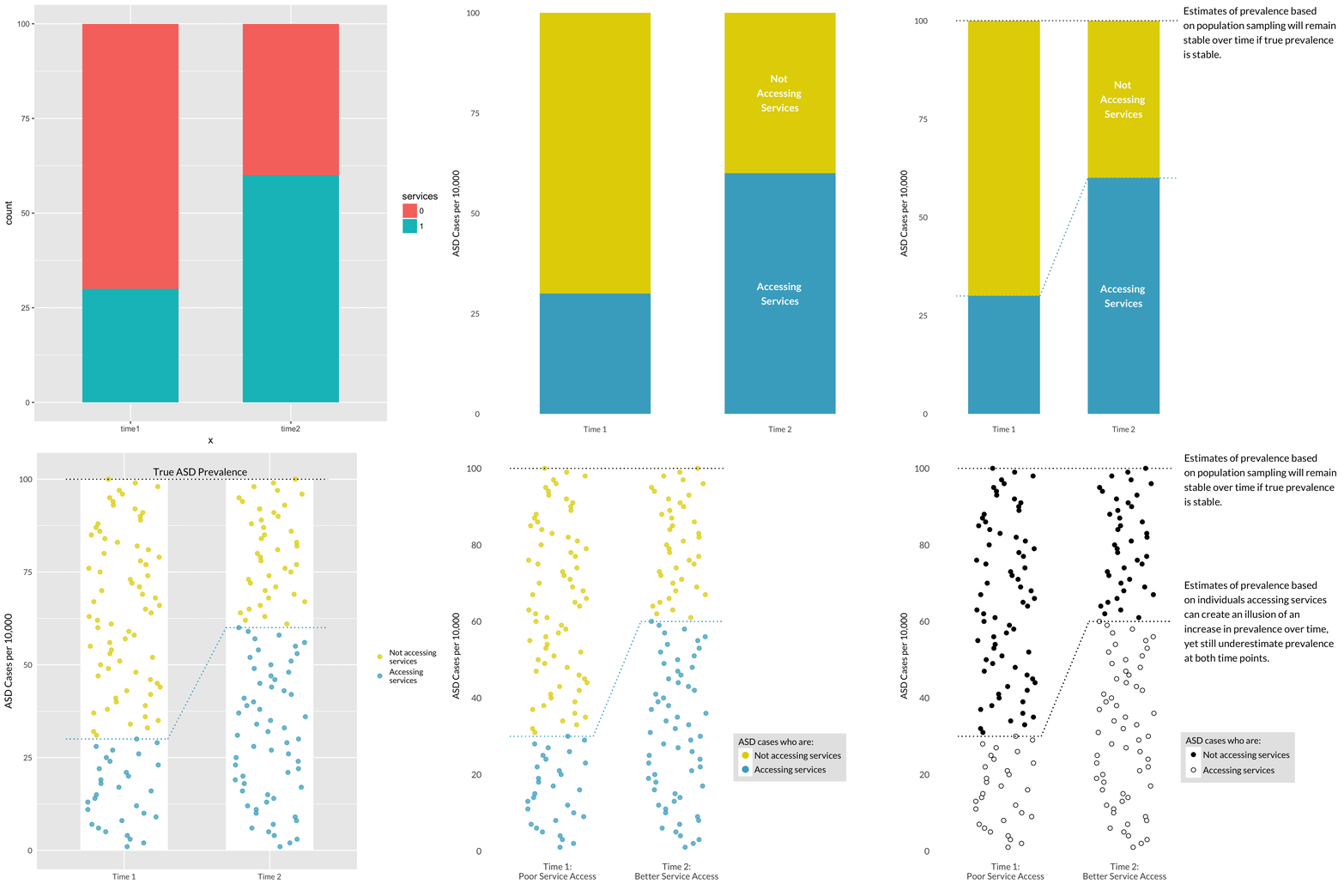
Multiple plots on a slide

First, ask yourself, must you include multiple plots on a slide? For example, is your narrative about comparing results from two plots?

  • If no, then don’t! Move the second plot to to the next slide!

  • If yes, use columns and sequential reveal.

Quarto

Writing your project report with Quarto

  • Figure sizing: fig-width, fig-height, etc. in code chunks.

  • Figure layout: layout-ncol for placing multiple figures in a chunk.

  • Further control over figure layout with the patchwork package.

  • Chunk options around what makes it in your final report: message, echo, etc.

  • Cross referencing figures and tables.

  • Adding footnotes and citations.

Cross referencing figures

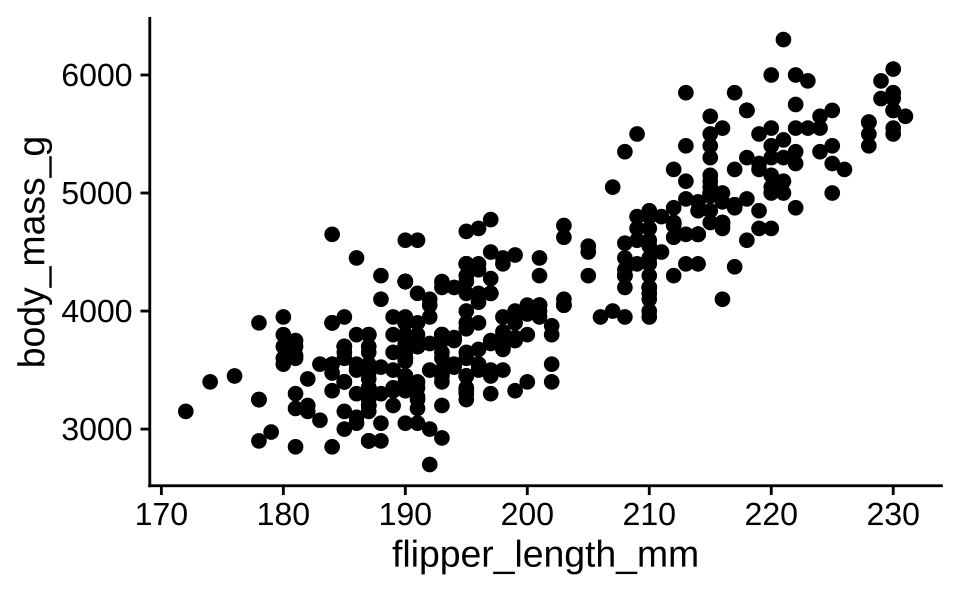
As seen in Figure 1, there is a positive and relatively strong relationship between body mass and flipper length of penguins.

ggplot(penguins, aes(x = flipper_length_mm, y = body_mass_g)) +
  geom_point()
Figure 1: The relationship between body mass and flipper length of penguins.
As seen in @fig-penguins, there is a positive and relatively strong relationship between body mass and flipper length of penguins.

```{r}
#| label: fig-penguins

ggplot(penguins, aes(x = flipper_length_mm, y = body_mass_g)) +
  geom_point()
```

Cross referencing tables

Table 1 displays summaries of flipper length by species.

penguins |>
  group_by(species) |>
  summarize(
    Mean = mean(flipper_length_mm, na.rm = TRUE),
    Median = median(flipper_length_mm, na.rm = TRUE),
    SD = sd(flipper_length_mm, na.rm = TRUE)
  ) |>
  knitr::kable(digits = 3)
Table 1: Flipper length summaries by species
species Mean Median SD
Adelie 189.954 190 6.539
Chinstrap 195.824 196 7.132
Gentoo 217.187 216 6.485
@tbl-penguins displays summaries of flipper length by species.

```{r}
#| label: tbl-penguins
#| tbl-cap: Flipper length summaries by species

penguins |>
  group_by(species) |>
  summarize(
    Mean = mean(flipper_length_mm, na.rm = TRUE),
    Median = median(flipper_length_mm, na.rm = TRUE),
    SD = sd(flipper_length_mm, na.rm = TRUE)
  ) |>
  knitr::kable(digits = 3)
```

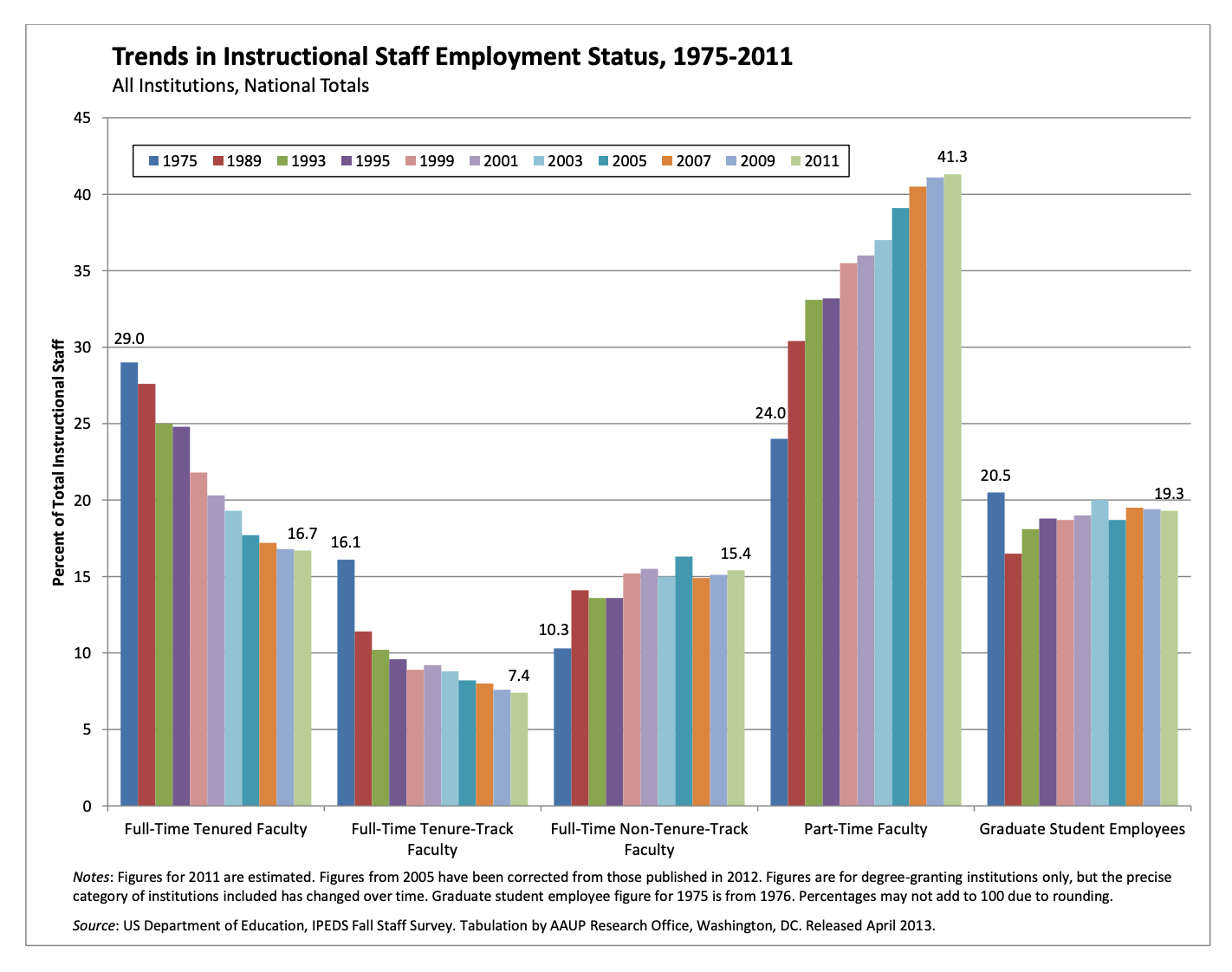
Take A Sad Plot & Make It Better

Going the extra mile

ae-14-effective-dataviz

  • Go to your ae project in RStudio.

  • If you haven’t yet done so, make sure all of your changes up to this point are committed and pushed, i.e., there’s nothing left in your Git pane.

  • If you haven’t yet done so, click Pull to get today’s application exercise file: ae-14-effective-dataviz.qmd.

  • Work through the application exercise in class, and render, commit, and push your edits.

Data prep

Code
library(tidyverse)
library(scales)

staff <- read_csv("data/instructional-staff.csv")

staff_long <- staff |>
  pivot_longer(
    cols = -faculty_type, names_to = "year",
    values_to = "percentage"
  ) |>
  mutate(
    percentage = as.numeric(percentage),
    faculty_type = fct_relevel(
      faculty_type,
      "Full-Time Tenured Faculty",
      "Full-Time Tenure-Track Faculty",
      "Full-Time Non-Tenure-Track Faculty",
      "Part-Time Faculty",
      "Graduate Student Employees"
    ),
    year = as.numeric(year),
    faculty_type_color = if_else(faculty_type == "Part-Time Faculty", "firebrick3", "gray40")
  )

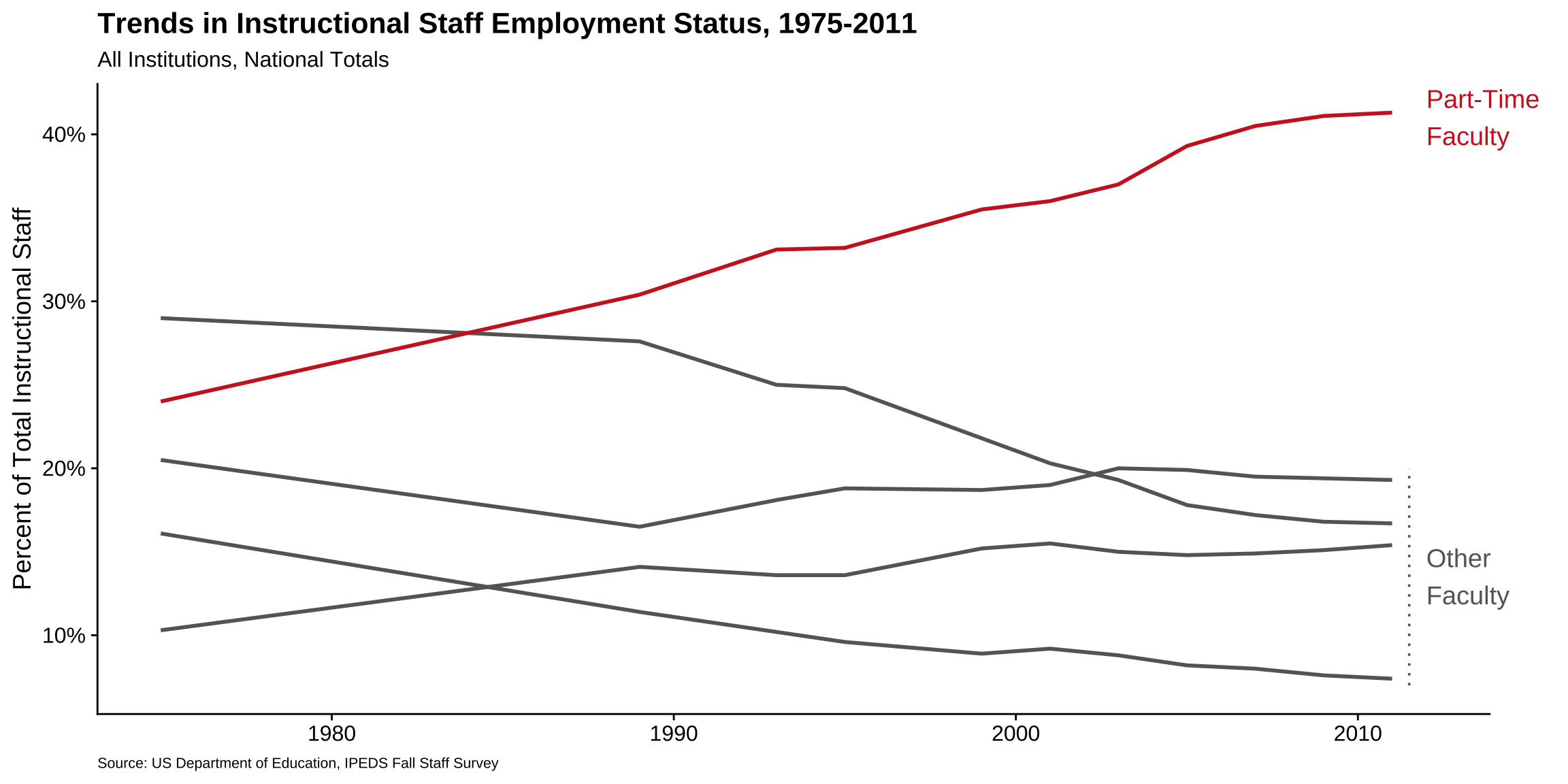
Pick a purpose

Code
p <- ggplot(
  staff_long,
  aes(
    x = year,
    y = percentage,
    color = faculty_type_color, group = faculty_type
    )
  ) +
  geom_line(linewidth = 1, show.legend = FALSE) +
  labs(
    x = NULL,
    y = "Percent of Total Instructional Staff",
    color = NULL,
    title = "Trends in Instructional Staff Employment Status, 1975-2011",
    subtitle = "All Institutions, National Totals",
    caption = "Source: US Department of Education, IPEDS Fall Staff Survey"
  ) +
  scale_y_continuous(labels = label_percent(accuracy = 1, scale = 1)) +
  scale_color_identity() +
  theme(
    plot.caption = element_text(size = 8, hjust = 0),
    plot.margin = margin(0.1, 0.6, 0.1, 0.1, unit = "in")
  ) +
  coord_cartesian(clip = "off") +
  annotate(
    geom = "text",
    x = 2012, y = 41, label = "Part-Time\nFaculty",
    color = "firebrick3", hjust = "left", size = 5
  ) +
  annotate(
    geom = "text",
    x = 2012, y = 13.5, label = "Other\nFaculty",
    color = "gray40", hjust = "left", size = 5
  ) +
  annotate(
    geom = "segment",
    x = 2011.5, xend = 2011.5,
    y = 7, yend = 20,
    color = "gray40", linetype = "dotted"
  )

p

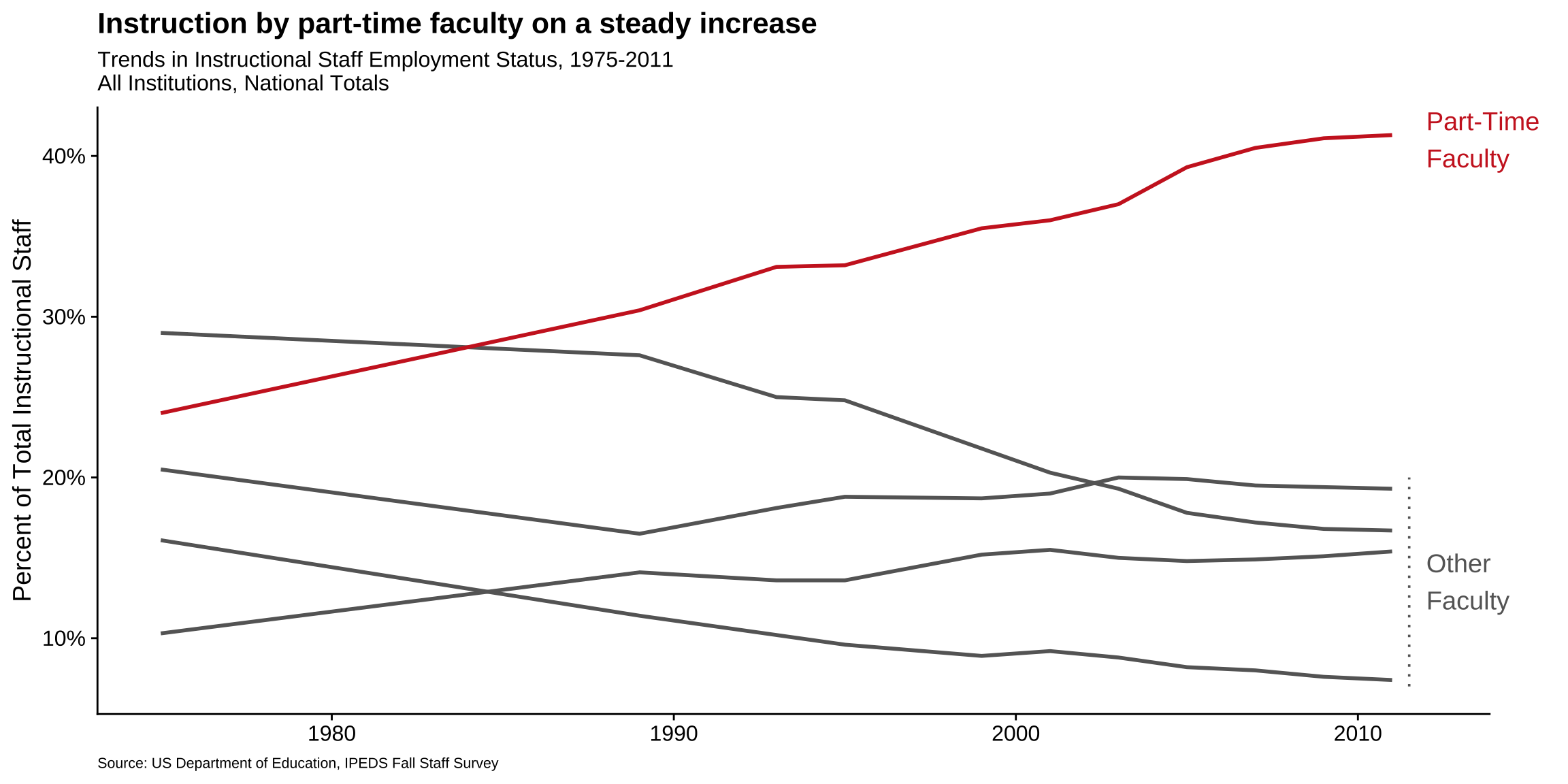
Use labels to communicate the message

Code
p +
  labs(
    title = "Instruction by part-time faculty on a steady increase",
    subtitle = "Trends in Instructional Staff Employment Status, 1975-2011\nAll Institutions, National Totals",
    caption = "Source: US Department of Education, IPEDS Fall Staff Survey",
    y = "Percent of Total Instructional Staff",
    x = NULL
  )

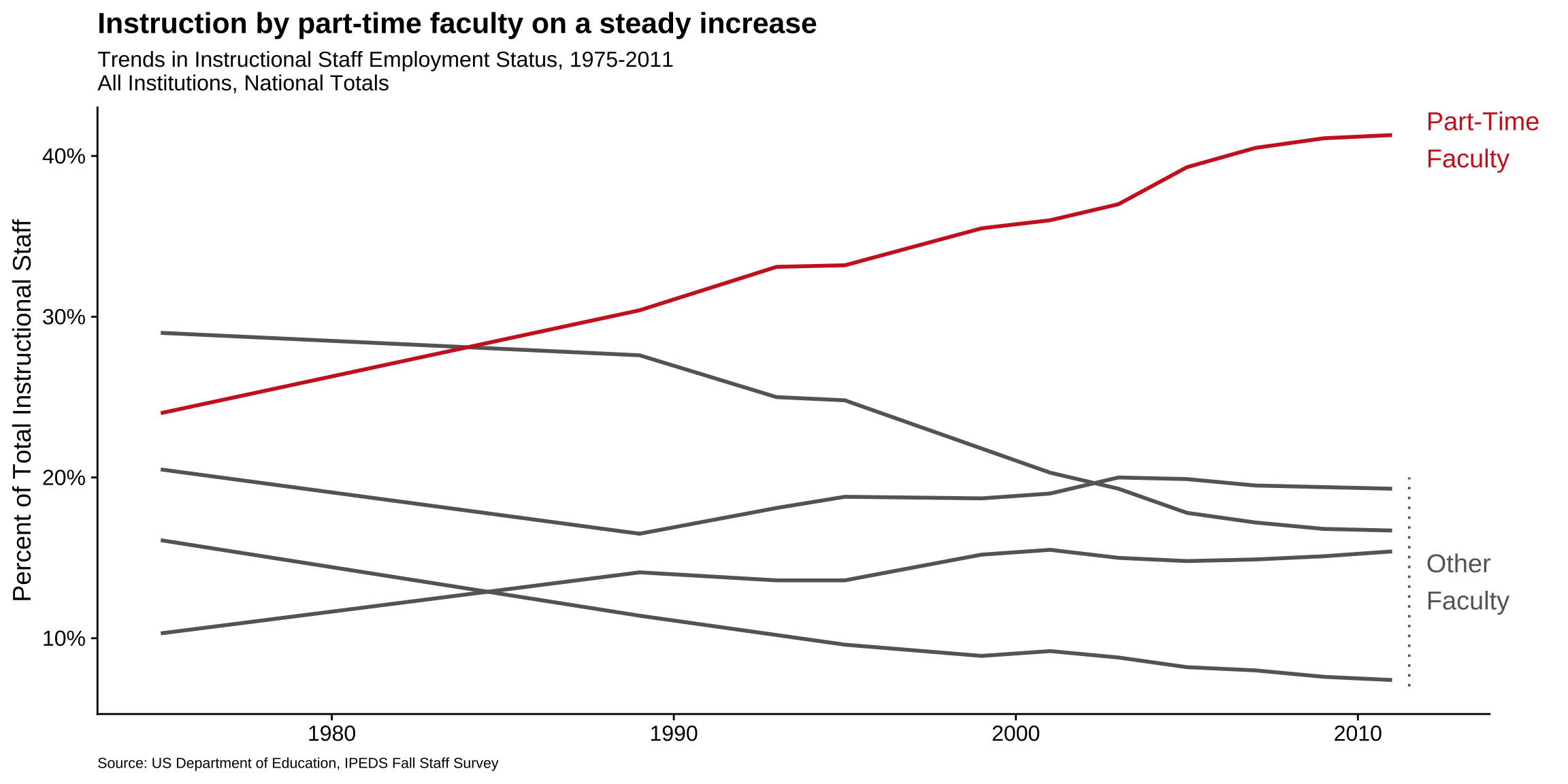
Simplify

Code
p +
  labs(
    title = "Instruction by part-time faculty on a steady increase",
    subtitle = "Trends in Instructional Staff Employment Status, 1975-2011\nAll Institutions, National Totals",
    caption = "Source: US Department of Education, IPEDS Fall Staff Survey",
    y = "Percent of Total Instructional Staff",
    x = NULL
  ) +
  theme(panel.grid.minor = element_blank())

Summary

  • Represent percentages as parts of a whole
  • Place variables representing time on the x-axis when possible
  • Pay attention to data types, e.g., represent time as time on a continuous scale, not years as levels of a categorical variable
  • Prefer direct labeling over legends
  • Use accessible colors
  • Use color to draw attention
  • Pick a purpose and label, color, annotate for that purpose
  • Communicate your main message directly in the plot labels
  • Simplify before you call it done (a.k.a. “Before you leave the house, look in the mirror and take one thing off”)